
When beginners first start investing, one of the biggest worries is choosing the right moment to enter the market. Many people are afraid of investing just before prices fall. Others keep waiting for the perfect opportunity and end up doing nothing for months. This fear is very common, especially for new investors who do not yet feel confident about market timing.
That is why dollar-cost averaging is such an important concept. It offers a simple and practical way to invest without needing to predict the perfect moment. Instead of trying to guess when prices will rise or fall, you invest a fixed amount of money at regular intervals.
For many beginners, this approach feels much easier and less stressful. It turns investing into a routine instead of a constant decision. It also helps reduce emotional reactions, which are often one of the biggest problems in investing.
In this guide, you will learn what dollar-cost averaging means, how it works, why many investors use it, and why it can be especially useful when you are just starting.
What Is Dollar-Cost Averaging?
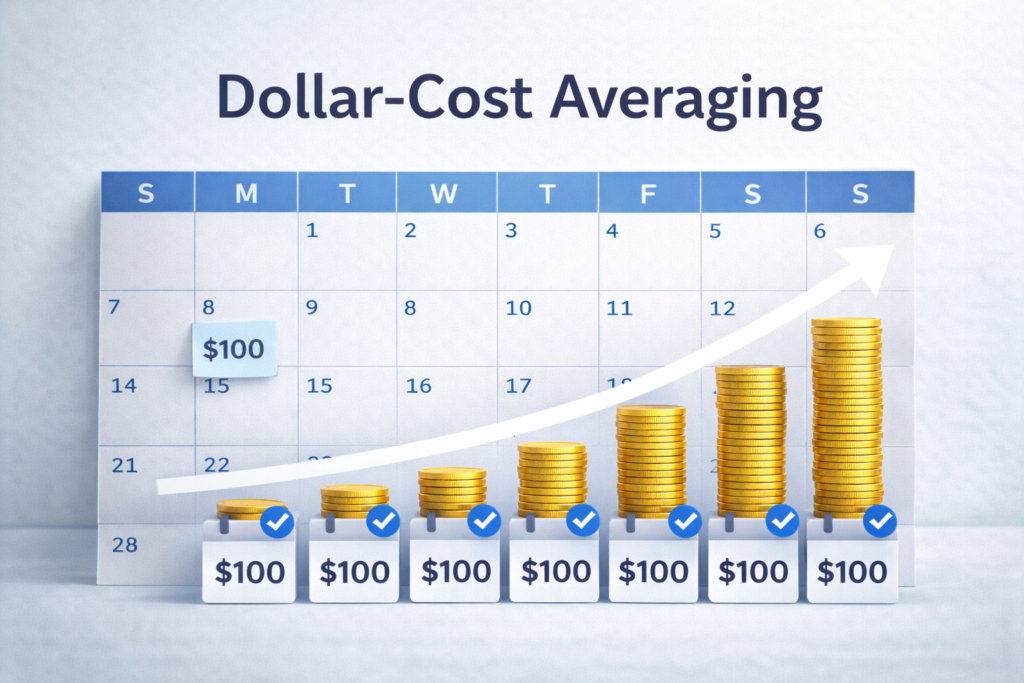
Dollar-cost averaging is an investing strategy where you invest the same amount of money at regular intervals, regardless of what the market is doing.
For example, instead of investing a large amount all at once, you might invest a smaller amount every week or every month. The key idea is consistency. You keep investing regularly whether prices are high, low, or somewhere in between.
This means that sometimes your fixed amount will buy more shares because prices are lower, and sometimes it will buy fewer shares because prices are higher. Over time, this can help smooth out the average price you pay.
The strategy is simple, but that simplicity is one of its biggest strengths. Beginners do not need to spend time trying to predict short-term market movements. They just follow a steady plan.
Dollar-cost averaging does not guarantee profit and does not eliminate risk, but it can make investing more structured and less emotional.
How Dollar-Cost Averaging Works
The easiest way to understand dollar-cost averaging is to compare it with investing all your money at once.
Imagine you have 600 dollars or euros to invest. One option is to invest the entire amount today. Another option is to invest 100 each month for six months.
If you invest all at once, your result depends heavily on the price at that moment. If the market falls right after you buy, your investment may lose value quickly. If the market rises, you benefit immediately. This approach can work well, but it also creates pressure because everything depends on one decision.
With dollar-cost averaging, your money enters the market gradually. When prices are high, your fixed amount buys fewer units. When prices are low, it buys more. This spreads your entry points across time instead of depending on a single moment.
For beginners, that can feel much more manageable. It removes the need to constantly ask, “Is now the right time?” and replaces that question with a regular investing habit.

Why Beginners Find It Helpful
One reason beginners like dollar-cost averaging is that it reduces pressure. New investors often feel overwhelmed by the fear of making one big mistake. If they invest everything at once and the market falls, they may feel they failed immediately.
A gradual approach feels less intimidating. It makes investing easier to start because the amounts are smaller and the process feels more controlled.
Another reason it helps is that it supports discipline. Instead of reacting to headlines, trends, or emotions, you follow a plan. That is very valuable because emotional decisions are one of the most common causes of beginner mistakes.
Dollar-cost averaging also fits well with the way many people manage money in real life. Most people are paid regularly, not all at once. So investing a fixed amount each month often matches the natural rhythm of income and budgeting.
For someone building their first portfolio, that makes the strategy practical as well as psychologically helpful.
It Helps Reduce Emotional Investing
One of the biggest challenges in investing is emotion. When prices rise quickly, people often feel pressure to buy before they miss out. When prices fall, fear makes them want to wait or sell. This emotional cycle can lead to inconsistent decisions.
Dollar-cost averaging helps reduce that problem because it gives you a fixed routine. You invest on schedule instead of letting your feelings decide for you.
This does not mean emotions disappear completely. Market movements can still affect how you feel. But a structured plan makes it easier to stay calm because your actions are already decided in advance.
That matters more than many beginners realize. A strategy is not only about numbers. It is also about behavior. The best plan is often the one that helps you stay consistent.
For many investors, dollar-cost averaging works well not because it is exciting, but because it prevents emotional overreactions.
Does Dollar-Cost Averaging Always Beat Lump-Sum Investing?
Not always.
If the market keeps rising steadily, investing all your money at once can sometimes produce better results because more money is invested earlier. In other words, your capital has more time in the market.
This is why dollar-cost averaging should not be seen as a magic strategy that always outperforms. Its value is not just about maximizing return in every possible situation. Its value is also about reducing timing pressure and helping investors stay committed.
For a beginner, the difference between the two approaches is often less important than simply starting and staying consistent. A perfect strategy that causes stress or hesitation may be less useful than a simple one you can actually follow.
That is why dollar-cost averaging matters. It may not always produce the highest possible result, but it often produces a more comfortable and sustainable investing experience.
What Can You Use It For?
Dollar-cost averaging can be used for many types of investments. It is especially common with broad long-term investments such as ETFs, index funds, and diversified portfolios.
That is because these types of assets are often chosen for steady long-term growth rather than short-term trading. Investing into them regularly makes sense for many beginners who want to build habits and reduce the stress of timing.
It can also work with individual stocks, although that usually requires more confidence and more tolerance for concentration risk. Some people use it with crypto as well, but volatility there is much higher, so beginners should be more cautious.
In general, dollar-cost averaging works best when paired with long-term thinking. It is not designed for quick speculation. It is a strategy for steady participation in the market over time.
When This Strategy Makes the Most Sense
Dollar-cost averaging is especially useful when you are investing from regular income rather than from a large lump sum. If you are adding money each month from your salary, this approach often happens naturally.
It also makes sense when you are nervous about market timing. Many beginners spend too much time waiting for the “right” moment, and that waiting can delay progress. A regular investing plan helps solve that problem.
It is also a good fit for people who want simplicity. Not every investor wants to analyze the market constantly. Many people would rather choose a sound long-term investment and contribute to it steadily.
That said, the strategy works best when it is consistent. If you only invest when you feel comfortable, you are no longer really using dollar-cost averaging. The idea is to follow a system, not your emotions.
Common Misunderstandings
A common misunderstanding is thinking that dollar-cost averaging removes risk. It does not. Your investments can still lose value, especially in the short term. What it reduces is the risk of putting all your money in at one unfortunate moment.
Another misunderstanding is believing that the strategy only works when markets fall. In reality, it is designed to work across changing conditions. Its strength is not based on one market situation, but on regular and disciplined participation.
Some people also think it is only for beginners. That is not true. Many experienced investors also use dollar-cost averaging because it is simple, practical, and easy to maintain.
The strategy is basic, but basic does not mean weak. Sometimes the strongest investing habits are built on simple principles that are easy to repeat over time.
Conclusion
Dollar-cost averaging is a simple investing strategy that involves putting the same amount of money into the market at regular intervals. It helps beginners avoid the pressure of trying to time the market perfectly and can make investing feel more manageable.
Its biggest strength is not that it always produces the highest return. Its biggest strength is that it supports consistency, reduces emotional decisions, and makes it easier to start with confidence.
For beginners, that matters a lot. Investing is not only about choosing the right asset. It is also about finding a method you can stick with over time. Dollar-cost averaging gives many new investors exactly that: a clear and repeatable way to build long-term investing habits.