
For beginners ETFs are one of the easiest ways to start investing. They are simple and help spread out your money. This makes them less stressful than picking stocks.
Many new investors still feel unsure about buying an ETF after understanding what it is. They wonder how to buy one.
This is a question. The idea of placing your investment can feel scary. Learning about investing is one thing. Actually doing it is different.
The good news is that buying your ETF is easy. You do not need to be an expert. You just need to understand the basics of ETFs. You need to use a platform to buy them.
In this guide you will learn how to buy your ETF step by step. You will know what to look out for as a beginner. You will learn how to make your purchase, with confidence when buying an ETF.
What You Need Before Buying an ETF
Before you buy your ETF you need to have a few basic things ready.
First you need to have an investment account or a broker that lets you invest in Exchange Traded Funds. Most investing platforms that are good for beginners do support Exchange Traded Funds. The way they look and the things you can do on them can be different. Some platforms are very simple and easy to use which is great for people who are just starting out while others have a lot of tools that you might not need right away.
Second you need to have some money that you can invest. You do not need a lot of money to start with. A lot of people who’re new to investing start, with a small amount of money and then add more over time. The important thing is that the money you invest should be money that you can leave alone and not need to use away.
Third you need to know what an Exchange Traded Fund is. You do not need to be an expert. You should know that an Exchange Traded Fund is a group of investments all together and that different Exchange Traded Funds can follow different markets or industries.
Once you have these basic things taken care of buying your Exchange Traded Fund becomes a lot easier.
Step 1: Choose a Platform That Lets You Buy ETFs
The first thing you need to do is pick the platform you will use for investing in ETF. This is where you will look for the ETF you want put money into your account and buy the ETF.
When you are just starting out it is an idea to choose a platform that is easy to use and understand. You do not want to feel confused by a lot of tools and features. A simple platform can make buying your ETF much easier and less scary.
When you are looking at platforms you should check a few things. Does the platform let you invest in ETF? Does it let you buy a part of an ETF if you do not have a lot of money? Are the fees reasonable, for you?
You do not need to find the platform right now. You just need one that lets you invest in ETF clearly and safely for now.
Step 2: Check What the ETF Includes
Not all ETFs are the same. Some follow a broad market. Others focus on one sector, one region, one theme, or a specific strategy. This is why you should never buy an ETF based only on its name.
Before buying, check what the ETF actually contains. Ask yourself simple questions. Does it invest in many companies or only a narrow group? Is it focused on one country or spread more broadly? Does it look stable and diversified, or does it feel highly specialized?
For most beginners, broad and diversified ETFs are often easier to understand and easier to hold over the long term. Narrow or highly thematic ETFs may sound exciting, but they can also carry more concentration risk.
The goal is not just to buy an ETF. The goal is to buy one that matches your intention.
Buying your ETF is a big deal when you are starting to invest but it is not that hard. Once you have a platform you know what the ETF is, you look at the costs and you decide how much money you want to spend it is pretty easy to do.
For people who are just starting out the best thing about ETFs is that they make it easy to start investing and they help you spread your money around so you do not put all your money in one place. That is why a lot of people think they are a first investment.

Step 3: Understand the Basic Costs
Another important thing to check is cost. ETFs are often known for being relatively low-cost, but that does not mean costs should be ignored.
Some ETFs have management fees, often called expense ratios or ongoing charges depending on the platform and region. There may also be broker fees, currency conversion fees, or spreads between buying and selling prices.
You do not need to become obsessed with tiny differences, especially when starting. But you should understand that costs matter over time. A product that seems good at first can become less attractive if hidden costs make it harder for your investment to grow.
For beginners, the main idea is simple: understand the basic fees before buying, and try to avoid making decisions without knowing what they may cost.
Step 4: Decide How Much to Invest
This is the point where many beginners hesitate. They understand the ETF, they have chosen the platform, but they still wonder how much money they should commit.
The answer depends on your budget, your confidence, and your plan. Some beginners start with a small amount because they want to learn the process first. Others invest a bit more if they already feel comfortable and have money set aside for long-term investing.
What matters most is that your first ETF purchase should feel manageable. You do not need to prove anything with the size of your first investment. The goal is not to make one dramatic move. The goal is to begin in a way that feels sustainable.
A smaller start can actually be helpful because it reduces pressure. It gives you a chance to experience the process and understand how it feels to own an investment without creating unnecessary stress.
Step 5: Search for the ETF and Review It One More Time
Once you know what ETF you want and how much you want to invest, search for it inside your platform. Most brokers let you find ETFs by name or ticker.
Before buying, review it one more time. Make sure it is the ETF you intended to choose. Check that the market, strategy, and general purpose match what you researched.
This extra pause may seem small, but it matters. Many beginner mistakes happen because people rush. A final review helps you confirm that you are not buying something different from what you originally planned.
This is also a good moment to make sure you understand whether you are placing a simple market order or using another type of order. Beginners usually benefit from keeping the process simple and avoiding unnecessary complexity.
Step 6: Make the Purchase
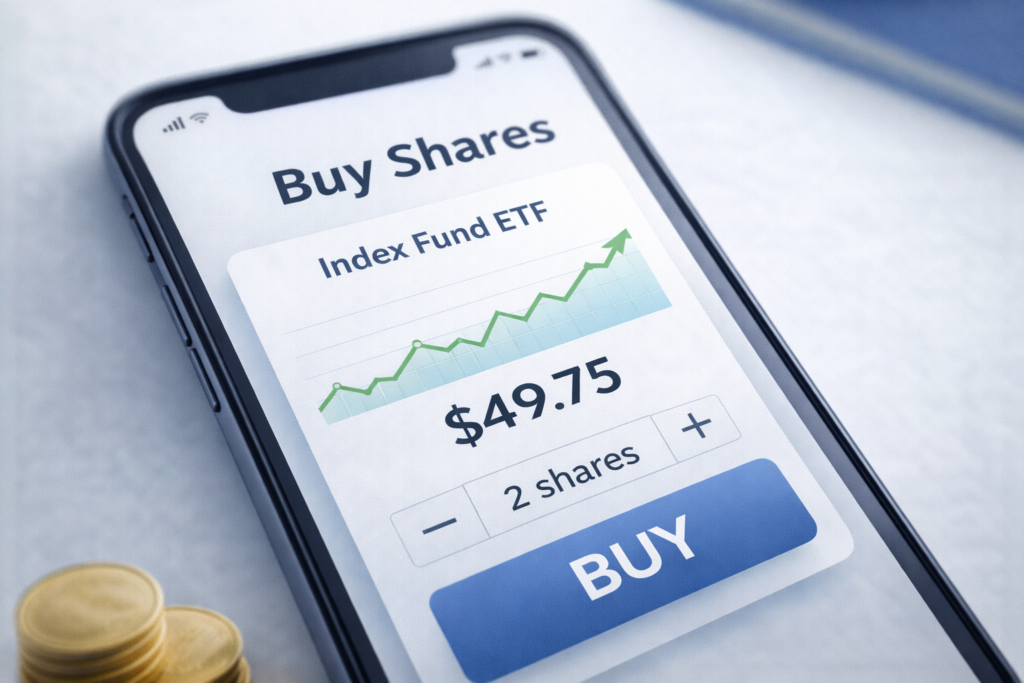
This is the final step. Once everything looks right, you place the order and buy the ETF.
For many beginners, this is the most emotional part of the process. Even after all the preparation, pressing the buy button can still feel like a big moment. That is normal.
Try to remember that one purchase does not need to be perfect. Investing is not about one heroic decision. It is about building consistent habits over time. Your first ETF purchase is not the final exam. It is the start of your experience as an investor.
Once the purchase is complete, you officially own your first ETF.
What to Do After Buying
After buying your first ETF, many beginners feel tempted to watch it constantly. They open the app every few hours, check the price, and react emotionally to even small changes.
This usually does more harm than good.
An ETF is often chosen for long-term investing, not for minute-by-minute excitement. After buying, the best thing to do is usually very simple: understand what you own, keep learning, and avoid unnecessary stress.
You can review your investment from time to time, but you do not need to obsess over every small movement. Markets go up and down. That is normal.
If your ETF fits your long-term plan, patience matters much more than daily checking.
Common Beginner Mistakes to Avoid
A common mistake is buying the first ETF you see without checking what it contains. Another is investing money you may need soon. Some beginners also become too focused on tiny short-term price changes, which creates anxiety rather than good decisions.
Another mistake is expecting one ETF purchase to solve everything immediately. Investing works better when seen as a long-term process, not a one-time event.
It is also a mistake to assume that all ETFs are automatically safe. While many are beginner-friendly, some are narrow, volatile, or highly specialized. That is why understanding the product matters before buying.
The good news is that these mistakes are easy to reduce when you slow down, review your choice, and start with a clear plan.
Conclusion
Buying your ETF is a big deal when you are starting to invest but it is not that hard. Once you have a platform you know what the ETF is, you look at the costs and you decide how much money you want to spend it is pretty easy to do.
For people who are just starting out the best thing about ETFs is that they make it easy to start investing and they help you spread your money around so you do not put all your money in one place. That is why a lot of people think they are a first investment.
The important thing to do is to take your time and not rush into anything. Your first ETF purchase is the start. Investing is not about making one choice. It is about doing things and keeping at it over time. Remember, your first ETF is the beginning and it is, about building good habits with your ETF investments.