
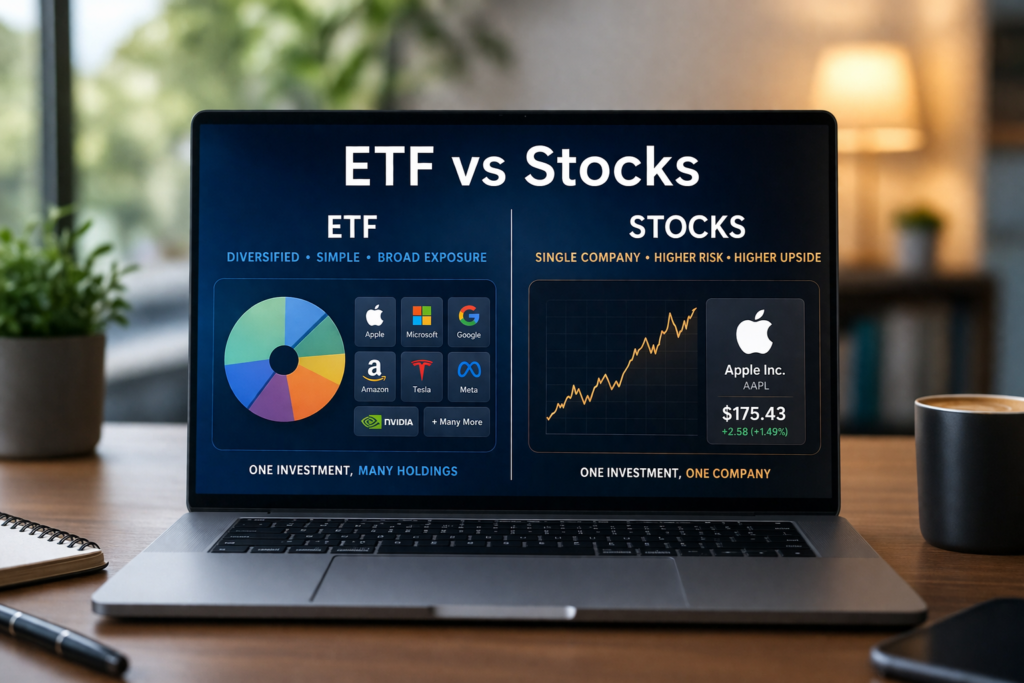
If you are new to investing, one of the first questions you will probably ask is whether you should buy ETFs or individual stocks. Both are popular investment options, and both can help you grow your money over time. But they are not the same, and they do not work in exactly the same way.
This is where many beginners get confused. Some people hear that stocks can bring high returns and assume they are the best choice. Others hear that ETFs are safer and think they should avoid stocks completely. The truth is more balanced. ETFs and stocks each have their own strengths, and the better choice depends on your goals, your experience, and how much risk you are comfortable taking.
For beginners, this decision matters because it shapes the way you start investing. If you choose something too complex or too risky too early, you may become stressed, discouraged, or confused. If you choose something that is simpler and easier to manage, you may be more likely to stay consistent and keep learning.
In this guide, you will learn the difference between ETFs and stocks, how each one works, and which option is usually better for beginner investors.
What Is a Stock?
A stock represents ownership in a single company. When you buy a stock, you are buying a small part of that business. If the company grows, becomes more profitable, or gains investor confidence, the stock price may increase. If the company struggles, the stock price may fall.
This is one reason stocks attract many investors. A good stock can deliver strong returns over time. If you choose the right company and hold it through years of growth, your investment can perform very well.
But owning individual stocks also means your money depends heavily on the success of one company. That makes stock investing more concentrated. If something goes wrong with that business, your investment may suffer even if the rest of the market is doing well.
For beginners, stocks can seem exciting because they feel direct and familiar. People know the names of large companies and may feel confident buying them. But knowing a company name is not the same as understanding whether it is a good investment. That is an important distinction.
What Is an ETF?
An ETF, or Exchange-Traded Fund, is a collection of investments bundled together into one product. Instead of buying one company, you buy a group of assets. These can include stocks from many companies, sometimes across different sectors or even entire markets.
This is what makes ETFs appealing to beginners. They offer diversification in a very simple form. Rather than depending on one company, your money is spread across many holdings at once.
For example, an ETF may include dozens or even hundreds of companies. If one of them performs poorly, the others can help reduce the impact. That does not remove all risk, but it usually makes the investment less volatile than owning a single stock.
This is one reason many beginner investors choose ETFs as a starting point. They are simpler to manage, easier to understand at a broad level, and often more stable than building a portfolio one stock at a time.
The Main Difference Between ETFs and Stocks
The biggest difference is concentration.
When you buy a stock, you are putting your money into one company. Your results depend on that company’s performance. This can lead to higher returns if the company does very well, but it also means more risk if things go wrong.
When you buy an ETF, you are spreading your money across many companies or assets. This creates diversification and usually reduces the effect of one bad result.
In simple terms, stocks are more focused, while ETFs are more spread out.
That difference shapes everything else. Stocks often require more research, more emotional control, and a stronger understanding of business performance. ETFs are often better suited to beginners because they reduce some of that pressure and complexity.
That does not mean ETFs are always better in every situation. It simply means they are often easier to start with.

Which Is Safer for Beginners?
In general, ETFs are usually safer for beginners than individual stocks. This is because they reduce concentration risk.
If a beginner buys one stock and that company performs badly, the loss can be significant. If the same beginner buys an ETF with many companies inside it, one weak company is less likely to damage the overall investment in the same way.
This is why diversification matters so much. Beginners are often still learning how markets work, how companies perform, and how to deal with market emotions. Starting with a diversified product gives them more room to learn without being exposed to the same level of company-specific risk.
Of course, safer does not mean risk-free. ETFs can still lose value, especially during broader market downturns. But for a beginner who wants a simpler and more balanced approach, ETFs are often the more comfortable option.
Which One Has More Growth Potential?
This question is a little more complex.
Individual stocks can have higher upside because one strong company can grow much faster than a broad ETF. If you pick an excellent stock early and hold it for years, the returns can be impressive.
But that higher upside comes with higher uncertainty. Many stocks do not outperform the market. Some remain flat, and others fall over time. The challenge is that beginners often do not yet know how to identify quality companies or evaluate risk properly.
ETFs usually offer slower but steadier growth because they reflect the performance of many investments together. They may not deliver dramatic wins from a single company, but they also reduce the chance of one bad choice hurting your entire portfolio.
So yes, stocks may offer more upside in some cases, but ETFs usually offer a more balanced and reliable path for beginners.
Which One Is Easier to Manage?
ETFs are generally easier to manage.
When you invest in individual stocks, you may feel the need to follow company news, earnings reports, leadership changes, and market sentiment. Even if you plan to invest long term, individual stocks often create more pressure to stay informed.
ETFs are simpler because much of that complexity is already built into the product. You do not need to track every company inside the ETF. You mainly need to understand what the ETF includes, what market or sector it follows, and whether it still fits your long-term goal.
For beginners, that simplicity can be a major advantage. It reduces stress, lowers the chance of emotional decisions, and makes investing easier to stick with over time.
Many people underestimate how valuable simplicity is. A simple strategy that you can follow consistently is often much more effective than a complicated one you do not fully understand.
Should Beginners Avoid Stocks Completely?
Not necessarily.
Some beginners enjoy learning about companies and want to own a few individual stocks as part of their investing journey. That can be perfectly reasonable, especially if they keep those positions small and understand the risks.
The key is balance. A beginner does not need to choose only stocks or only ETFs forever. Many investors build a core portfolio around ETFs and then add a small number of stocks on the side. This gives them the stability of diversification while also allowing room to learn about individual businesses.
So the real question is not whether stocks are bad for beginners. The question is whether beginners should rely too heavily on them too early. In many cases, that is where problems begin.
A stock can be part of a beginner portfolio. It just should not always be the foundation.
What Is the Best Choice for Most Beginners?
For most beginners, ETFs are usually the better place to start.
They are simpler, more diversified, easier to manage, and generally less stressful than owning individual stocks. They help new investors learn the basics of market behavior without depending too much on one company or one decision.
That does not mean beginners should never buy stocks. It simply means ETFs often provide a stronger foundation. Once a beginner gains more experience, understands risk better, and becomes more confident, adding a few individual stocks may make more sense.
Starting with ETFs is not boring. It is strategic. It allows you to build habits, stay consistent, and grow your understanding without exposing yourself to unnecessary complexity too early.
For most new investors, that is a very smart place to begin.
Conclusion
Both ETFs and stocks can play a role in investing, but they serve different purposes. Stocks offer direct ownership in one company and may provide higher upside, but they also come with greater concentration risk and require more research. ETFs offer diversification, simplicity, and a more balanced starting point.
For beginners, ETFs are usually the better choice because they make investing easier to understand and easier to manage. They reduce the chance that one mistake or one weak company will have too much impact on your portfolio.
As your knowledge grows, you may decide to mix both. But if you are just starting and want a solid foundation, ETFs are often the smarter first step.