
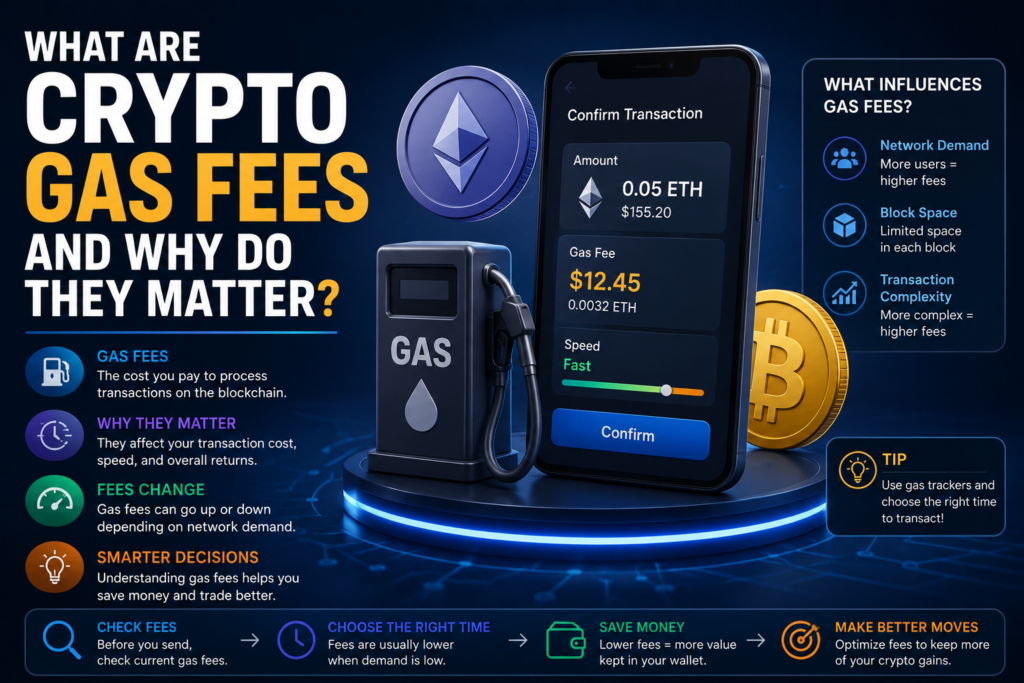
One of the first surprises many crypto beginners encounter is that buying or sending cryptocurrency often costs more than expected.
You might decide to transfer $100 worth of crypto, only to discover you’re paying an extra fee. Sometimes it’s a few cents. Other times it can be several dollars—or even much more during periods of heavy network activity.
These charges are known as gas fees.
Understanding gas fees is essential because they directly affect the cost of using blockchain networks. Whether you’re buying cryptocurrency, sending tokens, trading NFTs, interacting with decentralized finance (DeFi) applications, or simply moving assets between wallets, gas fees can significantly impact your overall returns.
In my experience, many beginners focus entirely on whether a cryptocurrency’s price will rise or fall. Yet they often overlook transaction costs, which can quietly reduce profits over time.
The good news is that gas fees are not random. Once you understand how they work, you’ll be much better equipped to use crypto efficiently and avoid costly mistakes.
What Are Crypto Gas Fees?
Gas fees are transaction fees paid to blockchain networks.
These fees compensate the computers (called validators or miners, depending on the blockchain) that process, verify, and secure transactions.
Whenever you perform an action on a blockchain, resources are required.
Examples include:
- Sending cryptocurrency
- Swapping tokens
- Buying NFTs
- Selling NFTs
- Using DeFi protocols
- Staking tokens
- Minting digital assets
- Executing smart contracts
Every action consumes network resources.
Gas fees are essentially the payment for those resources.
Think of gas fees like shipping costs.
The package is your transaction.
The blockchain is the delivery network.
Gas is what you pay to have the transaction processed and delivered.
Without gas fees, blockchains would be vulnerable to spam attacks because users could flood the network with unlimited transactions at no cost.
Why Are They Called “Gas” Fees?
The term originated with the Ethereum blockchain.
Ethereum introduced the concept of “gas” as a way to measure the computational work required to perform actions on the network.
More complex actions require more gas.
For example:
| Activity | Gas Usage |
|---|---|
| Sending ETH | Low |
| Swapping tokens | Medium |
| NFT purchase | Medium |
| Smart contract interaction | High |
| Complex DeFi transaction | Very High |
The more work the network must perform, the more gas is consumed.
Today, the term “gas fee” is widely used across many blockchain ecosystems, even though not every blockchain technically uses the same terminology.
Why Do Gas Fees Exist?
Gas fees serve several important functions.
1. Network Security
Validators and miners need incentives to secure the network.
Gas fees provide those incentives.
Without compensation, there would be little reason for participants to contribute computing power and maintain the blockchain.
2. Preventing Spam
Imagine if transactions were free.
Bad actors could send millions of fake transactions and overwhelm the network.
Gas fees create an economic cost that discourages abuse.
3. Prioritizing Transactions
Blockchain networks have limited capacity.
When many users want to transact at the same time, fees help determine which transactions get processed first.
Users willing to pay higher fees generally receive faster processing.
This creates a marketplace for block space.
How Gas Fees Work
Every blockchain transaction requires two key elements:
Gas Limit
The maximum amount of computational work allowed for the transaction.
More complex actions require higher gas limits.
Gas Price
The amount you’re willing to pay per unit of gas.
Higher gas prices generally increase transaction priority.
The total fee is usually calculated as:
Gas Fee = Gas Used × Gas Price
Fortunately, most wallets calculate this automatically.
You typically don’t need to perform the math yourself.
However, understanding the concept helps explain why fees change throughout the day.
Why Do Gas Fees Change?
Many beginners assume gas fees are fixed.
They aren’t.
Gas fees constantly fluctuate based on network demand.
Think of it like airline ticket prices.
When demand is low:
- Fees are cheaper.
- Transactions process easily.
When demand is high:
- Fees increase.
- Competition for block space rises.
This is why fees can vary dramatically within a few hours.
Factors That Affect Gas Fees
Network Congestion
This is the biggest factor.
When thousands of users are trying to transact simultaneously, fees rise.
Common causes include:
- Crypto bull markets
- Major token launches
- NFT mint events
- Meme coin hype
- Popular DeFi opportunities
Transaction Complexity
Sending Bitcoin is generally simpler than executing a complicated DeFi strategy involving multiple smart contracts.
More complexity usually means:
- More computational work
- More gas consumption
- Higher fees
Blockchain Design
Different blockchains process transactions differently.
As a result, fee structures vary significantly.
Some networks are designed for low-cost transactions.
Others prioritize decentralization or security, which may lead to higher costs.
Which Blockchains Have Gas Fees?
Almost every blockchain charges transaction fees.
However, costs can vary dramatically.
Ethereum
Ethereum is the most well-known network associated with gas fees.
Because it supports:
- DeFi
- NFTs
- Smart contracts
- Thousands of decentralized applications
It often experiences high demand.
As a result, Ethereum fees can sometimes become expensive.
Bitcoin
Bitcoin does not technically use Ethereum-style gas.
However, it still charges transaction fees.
Fees are paid to miners who confirm transactions.
Solana
Solana is known for relatively low transaction costs.
Many users choose Solana specifically because fees are typically much lower than Ethereum.
Polygon
Polygon was designed to reduce costs while maintaining compatibility with Ethereum-based applications.
Its fees are often only a fraction of Ethereum’s.
Avalanche
Avalanche generally offers lower fees than Ethereum while supporting smart contracts and DeFi applications.
BNB Chain
BNB Chain is another network known for relatively inexpensive transactions compared with Ethereum.
Why Gas Fees Matter for Investors
Many beginners underestimate how much transaction costs can impact returns.
Let’s look at a simple example.
Example 1
You invest:
- $100 in crypto
- Pay $10 in fees
Your investment starts at:
- $90 effective value
Before earning any profit, you already need to recover the fee cost.
Example 2
You buy and sell frequently.
- Buy fee: $5
- Sell fee: $5
- Transfer fee: $3
Total fees:
- $13
Small fees may seem insignificant individually, but they can add up quickly.
This is especially important for investors making frequent transactions.
Gas Fees and DeFi
Gas fees become even more important when using decentralized finance.
A single DeFi strategy may require:
- Approving a token
- Swapping a token
- Depositing funds
- Staking assets
- Claiming rewards
Each step may require a separate transaction.
Each transaction may incur a fee.
This means the total cost can become much larger than beginners expect.
In my experience, many newcomers are shocked to discover they spent more on fees than they earned from a small investment strategy.
This is why understanding transaction costs matters before entering DeFi.
Gas Fees and NFTs
NFT activity can also generate substantial gas costs.
Common NFT-related transactions include:
- Minting
- Buying
- Selling
- Listing
- Transferring
During popular NFT launches, fees can spike dramatically because thousands of users compete for limited block space.
In some cases, users have paid more in gas than the NFT itself cost.
This is one reason why many NFT projects have explored alternative blockchains with lower fees.
How to Reduce Crypto Gas Fees
The good news is that gas fees can often be minimized.
1. Use Networks With Lower Fees
Different blockchains have different costs.
Examples of lower-fee ecosystems often include:
- Solana
- Polygon
- Avalanche
- BNB Chain
Always compare transaction costs before moving assets.
2. Avoid Peak Activity Hours
Network congestion drives fees higher.
If a transaction isn’t urgent, waiting can sometimes reduce costs significantly.
Many experienced crypto users monitor network activity before transacting.
3. Batch Transactions
Instead of making multiple small transactions, consider combining activities when possible.
Fewer transactions generally mean fewer fees.
4. Avoid Overtrading
Beginners often trade too frequently.
Each trade creates additional costs.
Long-term investors typically pay fewer fees than active traders.
5. Check Estimated Fees Before Confirming
Most wallets display estimated transaction fees before approval.
Always review them carefully.
If the fee seems excessive, consider waiting or using another network.
Common Beginner Mistakes With Gas Fees
Ignoring Fees Entirely
Many beginners focus only on asset prices.
Transaction costs matter too.
Sending Small Amounts
Paying a $10 fee to move $20 worth of crypto is highly inefficient.
Always compare the fee to the transaction value.
Choosing the Wrong Network
Sending assets through an expensive network when a cheaper alternative exists can increase costs unnecessarily.
Frequent Trading
High transaction frequency can quietly erode profits.
Not Understanding Smart Contract Costs
DeFi and NFT transactions often cost more than simple transfers.
Many beginners underestimate this.
Are High Gas Fees Good or Bad?
The answer depends on perspective.
Why High Fees Can Be Positive
High fees often indicate:
- Strong network demand
- Active ecosystem usage
- Valuable block space
This can signal a healthy blockchain ecosystem.
Why High Fees Can Be Negative
High fees can:
- Discourage adoption
- Reduce accessibility
- Make small transactions impractical
- Lower investor returns
The ideal blockchain balances:
- Security
- Decentralization
- Affordability
Achieving all three perfectly remains one of the industry’s biggest challenges.
The Future of Crypto Gas Fees
Blockchain developers continuously work to reduce transaction costs.
Major innovations include:
- Layer 2 scaling solutions
- Rollups
- Improved consensus mechanisms
- Sharding technologies
- Faster blockchain architectures
The goal is simple:
Enable more transactions while keeping costs affordable.
As blockchain technology evolves, many experts expect transaction efficiency to improve further.
However, fees will likely always exist in some form because networks need mechanisms to prioritize transactions and reward validators.
Final Thoughts: Why Every Crypto Investor Should Understand Gas Fees
Gas fees may not be the most exciting part of cryptocurrency investing, but they are one of the most important.
They influence:
- Profitability
- Trading costs
- DeFi participation
- NFT activity
- Network choice
- Long-term investment efficiency
Beginners often focus entirely on price movements while overlooking transaction costs.
That can be a costly mistake.
Before making any crypto transaction, ask yourself:
- What is the fee?
- Is it reasonable?
- Is there a cheaper alternative?
- Does the potential return justify the cost?
Understanding gas fees won’t guarantee investing success.
But it will help you avoid unnecessary expenses and make smarter decisions as you navigate the crypto ecosystem.
And in investing, keeping more of your money often matters just as much as making more of it.
FAQs About Crypto Gas Fees
What are crypto gas fees?
Crypto gas fees are transaction fees paid to blockchain validators or miners for processing and securing transactions on a blockchain network.
Why do gas fees exist?
Gas fees help secure blockchain networks, prevent spam transactions, and prioritize transactions during periods of high demand.
Which blockchain has the highest gas fees?
Ethereum is commonly associated with higher gas fees due to its popularity and extensive smart contract ecosystem, although costs vary depending on network activity.
Can gas fees be avoided?
Not entirely. Most blockchain transactions require fees. However, users can reduce costs by choosing lower-fee networks or transacting during periods of lower demand.
Why do gas fees change constantly?
Gas fees fluctuate based on network congestion, transaction complexity, and competition for block space.
Are gas fees the same as exchange fees?
No. Gas fees are paid to the blockchain network, while exchange fees are charged by trading platforms for their services.
Do all cryptocurrencies have gas fees?
Most blockchain networks charge some type of transaction fee, although terminology and fee structures vary between networks.