
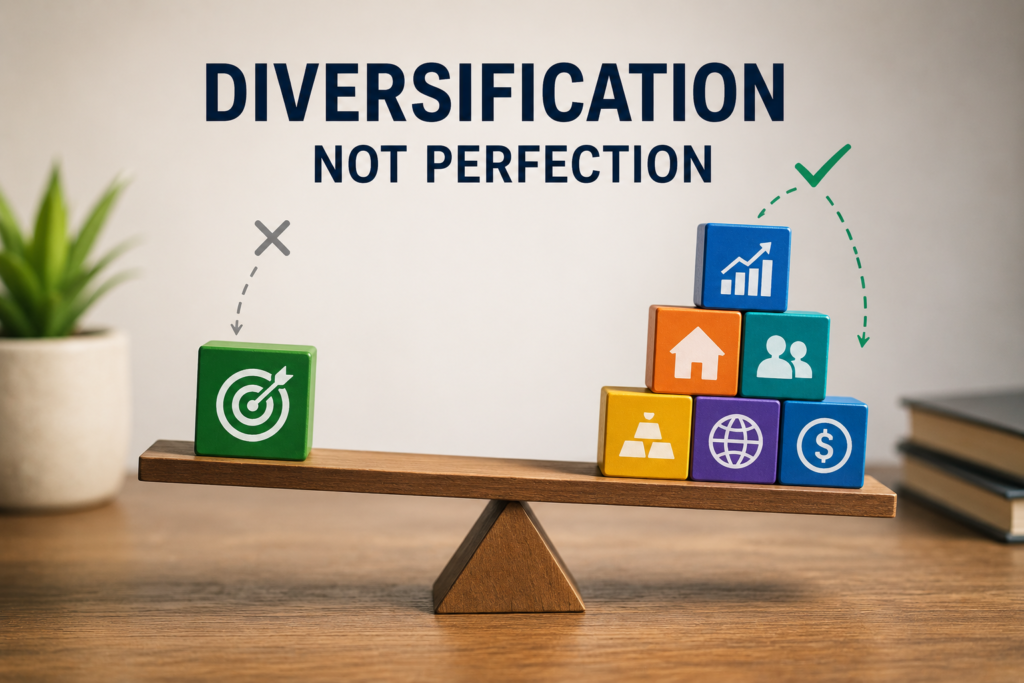
One of the biggest myths in investing is that successful investors constantly find the next winning stock.
Many beginners believe wealth comes from discovering a hidden opportunity before everyone else. They spend hours searching for the perfect stock, the perfect cryptocurrency, the perfect ETF, or the perfect market trend.
But here’s the reality:
Most long-term investing success comes not from finding the perfect investment but from building a portfolio that can survive uncertainty.
And that’s where diversification comes in.
Diversification is one of the most powerful risk-management tools available to investors. It won’t guarantee profits, and it won’t eliminate losses, but it can help reduce the impact of mistakes, market downturns, and unexpected events.
In my experience, beginners often underestimate how difficult it is to consistently identify future winners. Even professional investors struggle to predict which companies, sectors, or markets will outperform over the next decade.
That’s why successful investing is often less about being right all the time and more about avoiding catastrophic mistakes.
Diversification helps achieve exactly that.
What Is Diversification?
Diversification means spreading your investments across different assets rather than putting all your money into a single investment.
The basic idea is simple:
Don’t rely on one company, one sector, one country, or one asset class to determine your financial future.
Investor.gov defines diversification as a strategy that spreads investments among different assets to help reduce risk. The goal is to avoid excessive exposure to any single investment. (investor.gov)
Think about it this way:
If you own only one stock and that company struggles, your portfolio may suffer significantly.
If you own hundreds of investments, one failure becomes far less damaging.
Diversification acknowledges an important truth:
No one can predict the future with certainty.
The Problem With Searching for the Perfect Investment
Most beginners start investing with a simple goal:
“I just need to find the best investment.”
It sounds logical.
After all, if you could identify the next Amazon, Apple, Nvidia, or Bitcoin before everyone else, you’d likely make a fortune.
The challenge is that identifying future winners consistently is extremely difficult.
Even companies that seem unstoppable can experience:
- Competitive threats
- Regulatory changes
- Economic downturns
- Management failures
- Technological disruption
- Unexpected scandals
History is filled with businesses that once appeared invincible before falling dramatically.
This is why concentrating your portfolio around a single idea creates significant risk.
A great investment can become a bad investment if circumstances change.
Diversification accepts that nobody knows exactly what the future holds.
Why Diversification Matters More
Diversification matters because it focuses on what investors can control.
You cannot control:
- Future stock prices
- Economic cycles
- Interest rates
- Market sentiment
- Corporate decisions
- Global events
But you can control:
- Asset allocation
- Portfolio structure
- Risk exposure
- Diversification level
This distinction is important.
Instead of trying to predict every winner, diversified investors build portfolios designed to perform reasonably well under many different conditions.
In my opinion, this mindset shift is one of the biggest upgrades a beginner can make.
Investing becomes less about prediction and more about preparation.
Diversification Reduces Single-Investment Risk
Imagine two investors.
Investor A
Places $20,000 into one company.
Investor B
Places $20,000 into a diversified portfolio containing hundreds of investments.
Now imagine that one company experiences serious problems.
Investor A could lose a substantial portion of their portfolio.
Investor B may barely notice the impact.
This illustrates one of diversification’s greatest strengths:
It limits the damage caused by being wrong.
And every investor is wrong sometimes.
Even the most experienced professionals make investment mistakes.
Diversification provides protection against those inevitable errors.
The Difference Between Risk and Volatility
Many beginners confuse risk with volatility.
They’re related, but not identical.
Volatility
Volatility refers to how much prices move up and down.
Risk
Risk refers to the possibility of permanently losing money.
Diversification may not eliminate short-term volatility.
Markets can still decline.
However, diversification may reduce certain forms of risk by ensuring that your financial future isn’t tied to a single outcome.
Investor.gov explains that diversification helps reduce the impact of poor performance from individual investments because losses in some positions may be offset by gains in others. (investor.gov)
The goal isn’t to avoid every downturn.
The goal is to avoid situations where one bad decision destroys years of progress.
How Diversification Works
Different investments often perform differently under changing conditions.
For example:
| Asset | May Perform Better When |
|---|---|
| Stocks | Economic growth |
| Bonds | Economic uncertainty |
| Cash | Stability is needed |
| Real Estate | Property demand rises |
| Commodities | Inflation increases |
Because different assets react differently to economic conditions, combining them may create a more resilient portfolio.
This concept is known as diversification across asset classes.
It doesn’t guarantee profits.
But it can reduce dependence on a single market outcome.
Diversification Across Stocks
Many beginners think owning multiple stocks automatically means they’re diversified.
Not necessarily.
Imagine owning:
- Nvidia
- AMD
- Intel
- Qualcomm
- Broadcom
That’s multiple stocks.
But they’re all heavily connected to the technology sector.
If the technology industry struggles, the entire portfolio could suffer.
True diversification often means spreading investments across different industries such as:
- Technology
- Healthcare
- Consumer goods
- Energy
- Financial services
- Utilities
- Industrials
This helps reduce sector-specific risk.
Diversification Across Countries
Another overlooked form of diversification is geographic diversification.
Many investors concentrate entirely in their home country.
While this may feel comfortable, it creates concentration risk.
Different countries experience:
- Different economic cycles
- Different interest rates
- Different political environments
- Different growth opportunities
Global diversification can provide exposure to opportunities beyond a single market.
For example:
- United States
- Europe
- Japan
- Emerging markets
- Asia-Pacific regions
No one knows which region will outperform over the next decade.
Diversification allows investors to participate in multiple opportunities simultaneously.
Diversification Across Asset Classes
One of the most powerful forms of diversification involves combining different asset classes.
Examples include:
Stocks
Provide growth potential.
Bonds
Provide stability and income potential.
Cash
Provides liquidity and flexibility.
Real Estate
Adds alternative sources of returns.
Alternative Assets
May behave differently than traditional markets.
Asset allocation and diversification work together.
Asset allocation determines how much money goes into each category.
Diversification determines how broadly investments are spread within those categories.
Why Even Great Companies Can Be Bad Investments
This idea surprises many beginners.
A company can be amazing and still become a disappointing investment.
Why?
Because investing depends not only on business quality but also on expectations.
A fantastic company can already be priced for perfection.
If growth slows even slightly, investors may become disappointed.
Stock prices can fall despite strong businesses.
Diversification helps protect investors from overconfidence in any single story.
You don’t need to know which company will dominate the future.
You simply need exposure to many opportunities.
The Psychological Benefits of Diversification
Diversification isn’t just about numbers.
It also affects investor behavior.
One of the biggest reasons investors fail is emotional decision-making.
When a portfolio depends heavily on one investment, every news headline feels critical.
Every earnings report becomes stressful.
Every price decline feels personal.
A diversified portfolio often reduces emotional pressure.
You don’t need every investment to succeed.
You only need the overall portfolio to perform well over time.
In my experience, diversified investors often find it easier to stay invested during volatile markets because they know their future doesn’t depend on a single position.
Diversification and Market Crashes
Diversification does not make you immune to market crashes.
This is important to understand.
During major market downturns, many investments may fall simultaneously.
However, diversified portfolios often experience less severe damage than highly concentrated portfolios.
For example:
A portfolio concentrated in speculative technology stocks may fall dramatically during a tech crash.
A diversified portfolio containing:
- Multiple sectors
- Bonds
- Cash reserves
- International exposure
May experience a smoother ride.
The objective isn’t perfection.
The objective is resilience.
The Cost of Being Wrong
Let’s imagine two investors.
Investor A
Invests everything in one stock.
The company loses 80% of its value.
Investor A now needs a 400% gain simply to break even.
Investor B
Allocates 5% of the portfolio to that same stock.
The company loses 80%.
The overall portfolio impact is only 4%.
Investor B can recover much more easily.
This example highlights why diversification matters.
You don’t need every investment to be successful.
You need to avoid catastrophic losses.
Common Diversification Mistakes
Mistake 1: Owning Too Few Investments
A portfolio with one or two investments is highly vulnerable to individual failures.
Mistake 2: Owning Similar Investments
Buying multiple investments within the same sector may create the illusion of diversification.
True diversification requires variety.
Mistake 3: Chasing Recent Winners
Many investors load up on whatever performed best recently.
This often leads to concentration risk.
Mistake 4: Ignoring Asset Allocation
Diversification works best when combined with proper asset allocation.
Mistake 5: Believing Diversification Eliminates Risk
Risk still exists.
Diversification reduces certain risks but cannot eliminate uncertainty.
How Beginners Can Diversify Effectively
A beginner-friendly approach may include:
Multiple Asset Classes
- Stocks
- Bonds
- Cash
Multiple Sectors
- Technology
- Healthcare
- Consumer goods
- Financials
- Energy
Multiple Regions
- Domestic markets
- International markets
Multiple Companies
Avoid excessive concentration in one stock.
Many beginners achieve diversification through broad index funds or diversified ETFs because these products provide exposure to many companies simultaneously.
Diversification vs. Maximum Returns
A common criticism of diversification is:
“If I knew the winning investment, diversification would reduce my returns.”
That’s true.
If you knew with certainty which investment would outperform, diversification would be unnecessary.
The problem is nobody knows that in advance.
Diversification intentionally sacrifices the possibility of extraordinary gains from a single position in exchange for reducing the risk of devastating losses.
For most investors, this trade-off is worthwhile.
Because long-term wealth creation depends more on consistency than occasional lucky predictions.
Why Professional Investors Diversify
Professional investors manage billions of dollars.
Yet most do not place all their money into one investment.
Why?
Because they understand uncertainty.
They understand that:
- Forecasts can be wrong.
- Markets can surprise everyone.
- Economic conditions change.
- Unexpected events happen.
Diversification is not a sign of weakness.
It’s an acknowledgment of reality.
Diversification and Long-Term Wealth Building
The most successful long-term investors often focus on:
- Consistency
- Risk management
- Patience
- Discipline
- Diversification
Rather than chasing the next hot trend.
Diversification allows investors to stay in the game.
And staying invested is one of the most important drivers of long-term success.
You don’t need to predict every winner.
You need a portfolio that can survive mistakes, market downturns, and unexpected events.
Final Thoughts: Stop Looking for Perfect Investments
The search for the perfect investment is understandable.
Everyone wants to find the next big winner.
But investing isn’t about being right every time.
It’s about building a system that works even when you’re wrong.
Diversification acknowledges that the future is uncertain.
It spreads risk, reduces dependence on any single outcome, and helps investors remain disciplined through changing market conditions.
In my opinion, one of the most valuable lessons a beginner can learn is this:
You don’t need to find the perfect investment to become a successful investor.
You need a portfolio that can succeed even when some investments fail.
And that’s exactly what diversification helps you build.
FAQs About Diversification
What is diversification in investing?
Diversification is the practice of spreading investments across different assets, sectors, countries, and asset classes to help reduce risk.
Why is diversification important?
Diversification helps reduce the impact of poor performance from any single investment and may create a more balanced portfolio.
Can diversification eliminate risk?
No. Diversification reduces certain risks but cannot eliminate market risk or guarantee profits.
How many investments should a diversified portfolio contain?
There is no universal number, but effective diversification typically involves exposure to multiple companies, sectors, and asset classes rather than just a few investments.
Is diversification better than finding winning stocks?
For most investors, diversification is often more reliable because consistently identifying future winners is extremely difficult.
Can ETFs help with diversification?
Yes. Broad-market ETFs and index funds often provide exposure to many companies, sectors, and regions within a single investment.
Does diversification reduce returns?
Diversification may limit the impact of extraordinary gains from a single investment, but it can also reduce the impact of large losses, leading to more consistent long-term outcomes.