
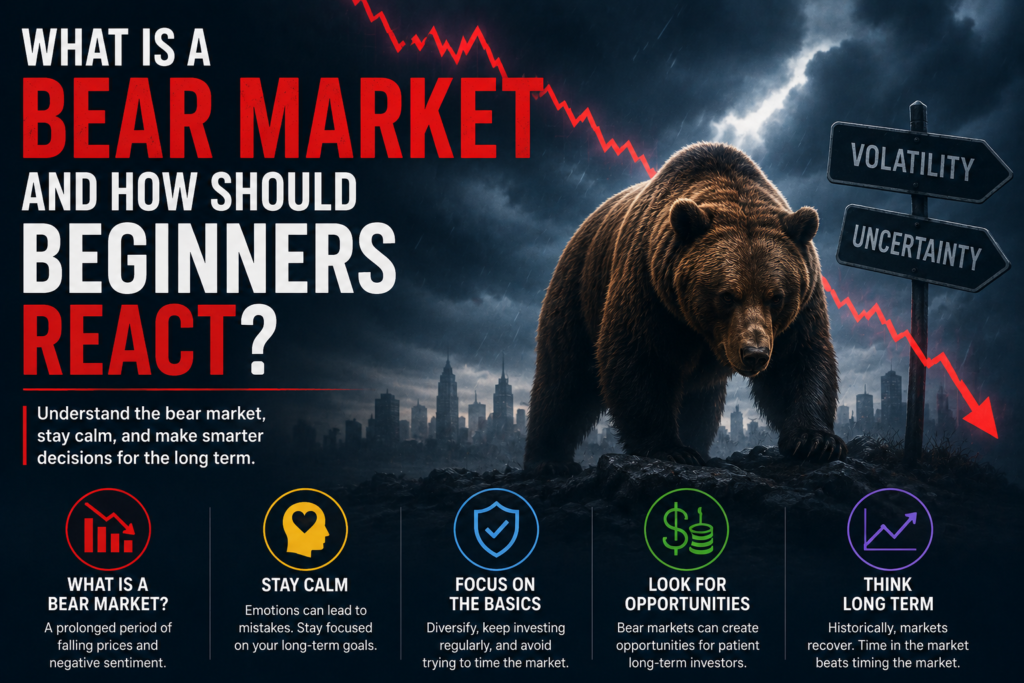
One of the hardest moments for beginner investors is watching the market fall.
At first, investing feels exciting. Prices rise, portfolios grow, and everyone online seems optimistic. Then suddenly headlines turn negative, stock prices drop for weeks or months, and fear takes over the market.
That environment is called a bear market.
For beginners, bear markets can feel personal. Seeing your investments lose value is uncomfortable, especially if you recently started investing. But bear markets are not rare accidents. They are a normal part of investing.
The real difference between successful long-term investors and emotional investors is often not what they do during bull markets. It is how they behave during bear markets.
Investor.gov defines a bear market as a period when stock prices fall and market sentiment becomes pessimistic, often associated with widespread declines of 20% or more from recent highs. (investor.gov)
In my experience, beginners usually think the biggest investing challenge is choosing the right stock. In reality, the bigger challenge is staying rational when markets become emotional.
Understanding bear markets can help you avoid panic decisions that hurt long-term wealth.
What Is a Bear Market?
A bear market is a prolonged period when financial markets decline significantly and investor confidence weakens.
Although definitions vary slightly, a bear market is commonly described as a drop of at least 20% from recent market highs.
Bear markets can affect:
- Stock markets
- Cryptocurrency markets
- Individual sectors
- Real estate
- Commodities
- Entire economies
During a bear market, investors often become fearful. News headlines turn negative. Economic concerns grow. People begin questioning whether markets will recover.
This emotional shift is important because investing is not only about numbers. Psychology plays a huge role.
FINRA explains that bear markets are generally periods of declining prices and widespread pessimism, often occurring alongside economic slowdowns or uncertainty. (finra.org)
Bear markets are unpleasant, but they are also normal.
Markets do not move upward forever in a straight line. Periods of optimism are usually followed by corrections, downturns, or recessions at some point.
Bear Market vs. Market Correction
Beginners often confuse bear markets with market corrections.
They are related, but not identical.
| Term | Typical Decline |
|---|---|
| Market correction | Around 10% decline |
| Bear market | Around 20% or more decline |
A correction is generally shorter and less severe.
A bear market is usually deeper, more emotional, and longer-lasting.
Not every correction becomes a bear market. But every bear market usually begins with a correction.
Investor.gov notes that corrections are shorter-term declines, while bear markets involve broader and more prolonged negative sentiment and price declines. (investor.gov)
For beginners, the emotional experience is often similar: seeing red numbers everywhere and wondering whether to sell.
Why Do Bear Markets Happen?
Bear markets can happen for many reasons.
Some common causes include:
- Economic recessions
- High inflation
- Rising interest rates
- Financial crises
- Banking instability
- Global conflicts
- Speculative bubbles bursting
- Corporate earnings weakness
- Investor panic
Sometimes markets fall because economic conditions genuinely weaken. Other times, markets fall because investors become overly fearful.
Markets are forward-looking. Investors constantly try to predict the future. When expectations deteriorate, prices can fall quickly.
The SEC explains that markets naturally fluctuate based on investor expectations, economic data, corporate earnings, interest rates, and broader financial conditions. (investor.gov)
This is why bear markets often feel chaotic.
Nobody knows exactly when they will begin or end.
How Long Does a Bear Market Last?
There is no fixed timeline.
Some bear markets last only a few months. Others can last much longer.
The important point for beginners is this:
Bear markets have happened many times throughout history, and markets have historically recovered over long periods.
That does not mean every individual stock recovers. Some companies fail completely. But broad diversified markets have historically moved through cycles of decline and recovery.
In my opinion, this is where perspective matters most. Beginners often view the current market decline as unique or permanent because it feels immediate and emotional. But experienced investors understand that volatility is part of the process.
The market environment always feels uncertain during a bear market. If it felt comfortable, prices probably would not be falling.
Why Bear Markets Feel So Scary
Bear markets are not difficult only because prices fall.
They are difficult because emotions become intense.
Common feelings include:
- Fear
- Panic
- Regret
- Anxiety
- Uncertainty
- Frustration
- FOMO about selling before prices fall further
When portfolios drop significantly, many beginners start questioning their entire investing strategy.
They wonder:
- “Did I make a mistake?”
- “Should I sell everything?”
- “What if the market never recovers?”
- “What if I lose all my money?”
This emotional pressure can lead to poor decisions.
FINRA warns that emotional investing during volatile markets may lead investors to buy or sell at the wrong times based on fear or excitement rather than long-term planning. (finra.org)
The hardest part of bear markets is usually psychological, not technical.
What Beginners Should NOT Do During a Bear Market
1. Do not panic sell
Panic selling is one of the most damaging investing mistakes.
Selling after large declines locks in losses and may prevent participation in future recoveries.
Investor.gov warns that reacting emotionally during market volatility may lead investors to abandon long-term plans at the wrong time. (investor.gov)
This does not mean you should never sell investments. But selling purely because prices are falling is usually emotional, not strategic.
In my experience, beginners often believe they can sell during fear and buy back later at the perfect time. In reality, timing both the exit and re-entry is extremely difficult.
Many investors sell after large declines and then miss the recovery because they stay afraid too long.
2. Do not check your portfolio constantly
During bear markets, refreshing your portfolio every hour usually increases stress.
Short-term price movements become emotionally exhausting.
The more often you stare at volatility, the harder it becomes to stay rational.
Long-term investing requires accepting that markets fluctuate.
That does not mean ignoring your finances completely. It means avoiding obsessive monitoring that encourages emotional reactions.
3. Do not invest money you need soon
One of the biggest beginner mistakes is investing short-term money too aggressively.
If you need the money within the next few years, market declines can create serious problems.
Emergency funds and short-term goals usually should not depend heavily on stock market performance.
MoneyHelper explains that short-term goals are generally better suited to cash savings rather than volatile investments because investments can lose value unexpectedly. (moneyhelper.org.uk)
Bear markets become much scarier when the money was needed soon.
4. Do not blindly follow online panic
During bear markets, social media becomes emotional.
Some people predict total collapse. Others aggressively push risky “buy the dip” trades. Fear spreads quickly online.
The SEC warns investors to be cautious about investment advice from social media, influencers, or emotionally charged online discussions during volatile periods. (investor.gov)
Emotional environments create emotional decisions.
And emotional investing rarely ends well.
How Beginners SHOULD React During a Bear Market
1. Stay calm and focus on your plan
Bear markets test discipline.
If your investment strategy made sense before markets fell, temporary declines do not automatically mean the strategy is broken.
This is why having a plan matters.
A long-term investor should expect volatility at some point. Bear markets are unpleasant, but they are part of normal investing cycles.
2. Review your time horizon
Ask yourself:
When do I actually need this money?
If the answer is decades away, short-term market declines may matter less than they feel right now.
Investor.gov explains that younger or long-term investors may be better positioned to tolerate market volatility because they have more time before needing the money. (investor.gov)
This perspective helps reduce panic.
3. Continue investing consistently if appropriate
For long-term investors, continuing to invest during bear markets may be beneficial.
When markets fall, prices become lower.
That means regular contributions may buy more shares than before.
This concept is called dollar-cost averaging.
Investor.gov describes dollar-cost averaging as investing a fixed amount regularly regardless of market conditions, which can reduce the emotional pressure of trying to time the market. (investor.gov)
In my experience, this is one of the hardest but most valuable beginner lessons:
The best long-term opportunities rarely feel comfortable in real time.
4. Revisit your asset allocation
Bear markets sometimes reveal that a portfolio was too aggressive.
If market declines cause unbearable stress, your allocation may need adjustment.
For example:
- Too many risky assets
- Not enough cash reserves
- No emergency fund
- Overconcentration in one sector
This is not necessarily a reason to panic sell. But it may be a reason to improve portfolio structure moving forward.
5. Focus on diversification
Diversification does not eliminate losses during bear markets, but it may reduce risk compared to concentrating everything in one investment.
Investor.gov explains that diversification involves spreading investments across different asset categories and securities to help reduce exposure to individual risks. (investor.gov)
A diversified investor may recover more steadily than someone heavily concentrated in speculative assets.
Historical Examples of Bear Markets
Bear markets are not new.
Examples include:
| Event | Approximate Period |
|---|---|
| Dot-com crash | 2000–2002 |
| Global financial crisis | 2007–2009 |
| COVID-19 market crash | 2020 |
| 2022 inflation/rate-hike bear market | 2022 |
Each period felt extremely uncertain at the time.
Headlines were negative. Fear was widespread. Many people believed markets might not recover soon.
But history shows that markets move through cycles.
That does not guarantee future performance, but it provides useful perspective.
What Makes Bear Markets Dangerous for Beginners
The biggest danger is usually not the market itself.
It is emotional decision-making.
Common beginner mistakes include:
- Selling at the bottom
- Taking excessive risk trying to recover losses
- Abandoning diversification
- Stopping investing completely
- Chasing speculative assets
- Constantly changing strategies
- Confusing temporary declines with permanent failure
In my opinion, successful investing often depends less on predicting markets and more on controlling behavior during stressful periods.
Bear markets expose emotional weaknesses.
That is why preparation matters.
Bear Markets Can Create Opportunities
This section must be understood carefully.
A bear market does not automatically mean “everything is cheap.” Some investments deserve to fall. Some companies never recover.
But broad market declines can create opportunities for disciplined long-term investors.
Why?
Because strong businesses and diversified funds may temporarily trade at lower prices due to fear and uncertainty.
Investor.gov notes that long-term investors may choose to continue investing through market downturns because markets historically move through cycles over time. (investor.gov)
This is where patience matters.
Bear markets often feel terrible in the moment. But some of the best long-term investing opportunities historically appeared during periods of widespread fear.
A Simple Beginner Bear Market Strategy
Here is a practical framework beginners can follow during market downturns.
Step 1: Protect your emergency fund
Do not invest money needed for near-term survival.
Your emergency fund exists precisely for uncertain periods.
Step 2: Avoid emotional decisions
Do not make major investment changes based purely on fear.
Pause before reacting.
Step 3: Continue learning
Bear markets are educational.
Use the period to:
- Understand risk tolerance
- Improve financial knowledge
- Learn about diversification
- Study portfolio structure
- Build emotional discipline
Step 4: Stay diversified
Avoid concentrating everything in speculative investments.
Diversification may help reduce extreme risk.
Step 5: Keep a long-term perspective
Temporary declines are painful, but long-term investing is measured in years and decades, not days.
How to Mentally Handle a Bear Market
This part matters more than people think.
A few mindset shifts can help beginners stay rational:
Accept volatility as normal
Market declines are not evidence that investing is “broken.”
Volatility is part of the process.
Separate emotions from strategy
Fear is natural.
But investment decisions should be based on planning, not panic.
Focus on time, not headlines
Headlines focus on daily fear.
Long-term investors focus on long-term goals.
Remember why you invested
Your plan likely existed for reasons larger than short-term market moves:
- Retirement
- Financial independence
- Wealth building
- Long-term security
Those goals usually take years.
Final Thoughts: Bear Markets Are Part of Investing
A bear market is not pleasant.
Prices fall. Fear spreads. Headlines become dramatic. Confidence disappears.
But bear markets are also normal.
Every investor eventually experiences them.
The key question is not whether bear markets will happen. The key question is how you will react when they do.
Beginners often believe successful investing means avoiding all downturns. In reality, long-term success usually depends more on discipline, patience, diversification, and emotional control.
You do not need to predict every market movement.
You need a strategy you can stick with when markets become uncomfortable.
Because in investing, surviving emotionally is often just as important as surviving financially.
FAQs About Bear Markets
What is a bear market?
A bear market is generally defined as a market decline of 20% or more from recent highs, often accompanied by widespread pessimism and fear.
How long do bear markets last?
There is no fixed timeline. Some last months, while others last longer. Markets historically move through cycles of decline and recovery over time.
Should beginners sell during a bear market?
Selling purely because of fear can lock in losses. Decisions should be based on financial goals, time horizon, and overall strategy rather than panic.
Is a bear market a good time to invest?
For long-term investors, lower prices may create opportunities. However, investment decisions should still match risk tolerance and financial goals.
What is the difference between a correction and a bear market?
A correction is usually a decline of around 10%, while a bear market typically involves declines of around 20% or more with broader negative sentiment.
How can beginners prepare for a bear market?
Build an emergency fund, diversify investments, avoid excessive risk, maintain a long-term perspective, and avoid emotional investing decisions.
Do markets always recover?
Markets have historically recovered over long periods, though individual investments may not. Diversification is important because not every company or asset survives downturns.