
Most beginners think investing is mainly about picking the “best” stock.
In reality, one of the most important investing decisions is something far less exciting but far more powerful: asset allocation.
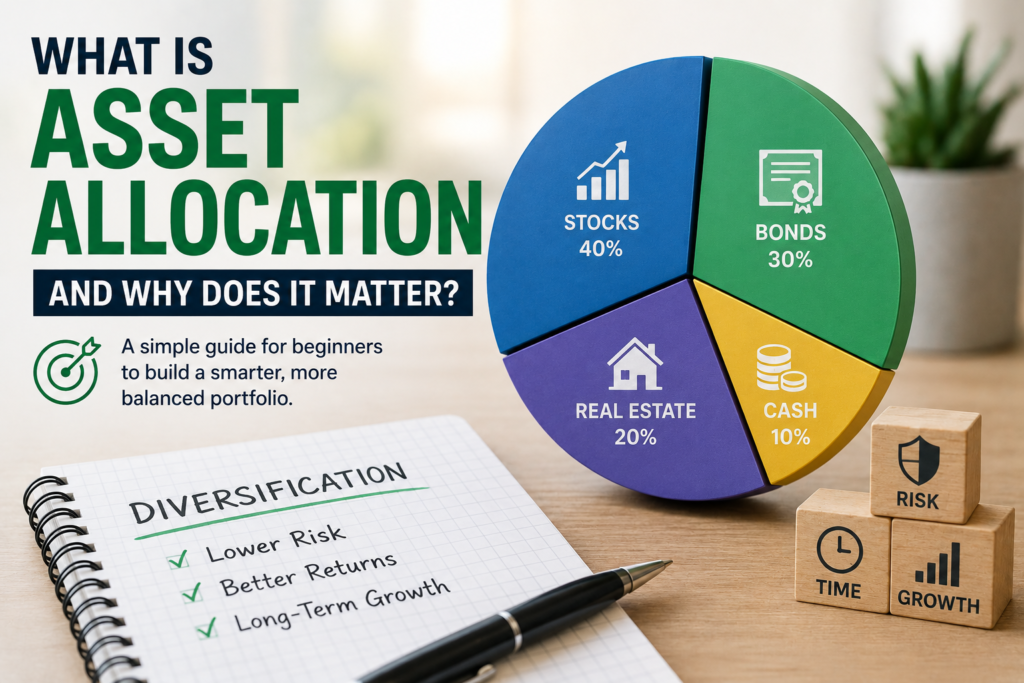
Asset allocation is the way you divide your money across different types of investments, such as stocks, bonds, cash, and other assets. It affects your risk, potential return, volatility, and long-term investing experience more than most individual investment choices.
You can own amazing investments and still build a weak portfolio if your allocation is wrong. On the other hand, a well-balanced asset allocation can help you manage risk, stay invested during market downturns, and build wealth more consistently over time.
Investor.gov defines asset allocation as dividing an investment portfolio among different asset categories such as stocks, bonds, and cash. It also explains that the process is personal because the ideal mix depends on goals, time horizon, and risk tolerance. (investor.gov)
In my experience, beginners often spend too much time searching for the perfect investment and not enough time building the right structure around their money. Asset allocation is that structure.
And it matters more than most people realize.
What Is Asset Allocation?
Asset allocation is the process of spreading your investments across different asset classes.
An asset class is simply a group of investments with similar characteristics and behavior.
The most common asset classes are:
| Asset Class | What It Includes |
|---|---|
| Stocks | Shares of companies |
| Bonds | Loans to governments or companies |
| Cash | Savings accounts, money market funds |
| Real estate | Property investments or REITs |
| Alternative assets | Commodities, crypto, private assets, collectibles |
When someone says they have a “70/30 portfolio,” they usually mean:
- 70% in stocks
- 30% in bonds or cash
That mix is their asset allocation.
The idea behind asset allocation is simple:
Different assets behave differently under different market conditions.
Stocks may grow faster over time but can be volatile. Bonds may provide more stability but usually lower returns. Cash offers safety and liquidity but may lose purchasing power to inflation over time.
The goal is not to eliminate risk completely. The goal is to build a portfolio with a level of risk you can actually handle.
Why Asset Allocation Matters
Asset allocation matters because it directly affects:
- Risk level
- Potential returns
- Portfolio volatility
- Emotional investing behavior
- Long-term consistency
- Ability to survive market downturns
Investor.gov explains that diversification and asset allocation help reduce risk because different assets do not always move in the same direction at the same time. (investor.gov)
This is important.
A portfolio made entirely of one asset class can be extremely vulnerable.
For example:
- A portfolio with only stocks may suffer large losses during a bear market.
- A portfolio with only cash may struggle against inflation.
- A portfolio with only bonds may grow too slowly for long-term goals.
Asset allocation helps balance those trade-offs.
In my opinion, one of the biggest beginner mistakes is focusing only on return potential while ignoring risk capacity. Your portfolio is not just supposed to grow. It is also supposed to survive difficult periods without causing panic.
The Main Asset Classes Explained
1. Stocks
Stocks represent ownership in companies.
Historically, stocks have offered some of the highest long-term returns, which is why they are often the main growth engine in a portfolio.
But stocks can also be volatile.
The value of stock investments may rise and fall significantly in the short term. During market crashes, stock-heavy portfolios can lose substantial value temporarily.
Stocks are generally better suited for:
- Long-term investing
- Retirement investing
- Wealth building
- Investors with higher risk tolerance
- Younger investors with long timelines
Examples include:
- Individual stocks
- Index funds
- ETFs
- Mutual funds
A stock allocation gives your portfolio growth potential, but it also increases volatility.
2. Bonds
Bonds are loans made to governments or companies.
When you buy a bond, you are essentially lending money in exchange for interest payments.
Bonds are usually considered less risky than stocks, though they still carry risks such as interest rate risk, inflation risk, and credit risk.
Bonds are often used for:
- Stability
- Income
- Lower volatility
- Portfolio diversification
FINRA explains that bonds may provide regular income and can help diversify a portfolio, although bond values can fluctuate based on interest rates and issuer strength. (finra.org)
A portfolio with bonds may not grow as fast during strong bull markets, but bonds can help reduce the emotional stress of market downturns.
3. Cash and Cash Equivalents
Cash includes:
- Savings accounts
- Money market funds
- Cash deposits
- Short-term government instruments
Cash offers safety and liquidity, meaning you can access it quickly.
But cash also has a downside:
Inflation.
If inflation rises faster than your savings interest rate, your purchasing power declines over time.
Cash is useful for:
- Emergency funds
- Short-term goals
- Stability
- Reducing volatility
- Upcoming expenses
Investor.gov notes that savings and cash products are typically safer and more accessible but may not keep pace with inflation over long periods. (investor.gov)
This is why many investors combine cash with growth-oriented investments rather than relying on cash alone.
4. Real Estate
Real estate can add diversification because property markets do not always behave exactly like stock markets.
Real estate exposure may include:
- Physical property
- Real estate investment trusts (REITs)
- Property funds
Real estate may provide:
- Rental income
- Long-term appreciation
- Inflation protection
But it can also involve:
- Illiquidity
- High costs
- Market cycles
- Interest-rate sensitivity
Not every beginner needs real estate exposure immediately, but it can become part of a diversified portfolio later.
5. Alternative Assets
Alternative assets include things like:
- Commodities
- Gold
- Hedge funds
- Private equity
- Collectibles
- Cryptocurrency
These assets can behave differently from traditional stocks and bonds, which may improve diversification in some situations.
But alternatives often come with:
- Higher risk
- Complexity
- Lower liquidity
- Greater volatility
For beginners, alternative assets usually should not become the foundation of a portfolio.
The Relationship Between Risk and Asset Allocation
The most important factor in asset allocation is risk.
Different allocations create different levels of volatility and potential return.
Example portfolios
| Portfolio Type | Stocks | Bonds | Cash |
|---|---|---|---|
| Conservative | 30% | 60% | 10% |
| Balanced | 60% | 35% | 5% |
| Aggressive | 90% | 10% | 0% |
A conservative portfolio may experience smaller declines during market crashes but lower long-term growth.
An aggressive portfolio may grow faster over decades but could experience painful short-term volatility.
There is no universally “best” allocation.
The best allocation is the one you can stick with during both good markets and bad markets.
This is where many beginners fail. They choose an aggressive portfolio during a bull market because high returns look exciting. Then the market falls 30%, panic sets in, and they sell at the worst possible time.
An allocation only works if you can emotionally survive it.
How Time Horizon Affects Asset Allocation
Time horizon means how long you plan to keep your money invested before needing it.
Generally:
- Longer timelines allow for more risk.
- Shorter timelines require more stability.
Investor.gov explains that your asset allocation should reflect both your time horizon and your ability to tolerate market fluctuations. (investor.gov)
Example
| Goal | Timeline | Typical Allocation Style |
|---|---|---|
| Emergency fund | Immediate | Mostly cash |
| House deposit in 2 years | Short term | Mostly cash and bonds |
| Retirement in 30 years | Long term | More stocks |
| Child education in 15 years | Medium/long term | Balanced growth allocation |
If you need the money soon, protecting capital becomes more important.
If you do not need the money for decades, temporary market declines may matter less because you have more time to recover.
Diversification vs. Asset Allocation
People often confuse diversification with asset allocation.
They are related, but not identical.
Asset allocation
Asset allocation decides how much money goes into each asset class.
Example:
- 70% stocks
- 20% bonds
- 10% cash
Diversification
Diversification spreads investments within those asset classes.
Example:
- U.S. stocks
- International stocks
- Technology stocks
- Healthcare stocks
- Government bonds
- Corporate bonds
Investor.gov explains that diversification means spreading investments across and within asset categories to reduce exposure to any single investment or risk. (investor.gov)
Think of asset allocation as building the structure of the portfolio, while diversification fills in the details.
Both matter.
Common Asset Allocation Strategies
1. Conservative Allocation
Focuses on stability and lower volatility.
Typical features:
- Higher bond allocation
- More cash
- Lower stock exposure
Usually better for:
- Retirees
- Risk-averse investors
- Shorter timelines
Potential downside:
- Lower long-term growth
- Inflation risk
2. Balanced Allocation
Attempts to balance growth and stability.
Typical features:
- Mix of stocks and bonds
- Moderate volatility
- Long-term growth potential
Usually better for:
- Medium-term investors
- Beginners
- Investors wanting moderate risk
Potential downside:
- Will still experience losses during market downturns
3. Aggressive Allocation
Focuses heavily on long-term growth.
Typical features:
- High stock allocation
- Very little cash
- Higher volatility
Usually better for:
- Younger investors
- Long-term investors
- Higher risk tolerance
Potential downside:
- Large short-term declines
Rebalancing: Keeping Your Allocation on Track
Over time, investments grow at different speeds.
If stocks rise sharply, your portfolio may become more stock-heavy than originally planned.
Rebalancing means adjusting the portfolio back to your target allocation.
Example:
Original allocation:
- 60% stocks
- 40% bonds
After a strong stock market rally:
- 75% stocks
- 25% bonds
Rebalancing would involve reducing stock exposure or increasing bond exposure to restore the original structure.
FINRA explains that rebalancing may help investors maintain a desired risk level by adjusting portfolios after market movements shift the allocation. (finra.org)
Rebalancing is important because portfolios naturally drift over time.
Without rebalancing, you may accidentally take more risk than intended.
Common Asset Allocation Mistakes
Mistake 1: Being too aggressive too early
Beginners often chase returns without understanding volatility.
A portfolio that looks exciting during a bull market can feel terrifying during a crash.
Mistake 2: Holding too much cash forever
Too much cash may reduce growth and lose purchasing power over time due to inflation.
Safety matters, but so does long-term growth.
Mistake 3: Ignoring time horizon
Money needed soon should usually not be heavily invested in volatile assets.
Short-term money and long-term money should not have identical allocations.
Mistake 4: Constantly changing allocation
Some investors panic during downturns and abandon their strategy.
Others become overly aggressive after strong market rallies.
Frequent emotional changes often hurt long-term performance.
Mistake 5: Copying someone else’s portfolio
Your allocation should reflect:
- Your goals
- Your timeline
- Your income stability
- Your risk tolerance
- Your emotional comfort
A strategy that works for someone else may be terrible for you.
A Simple Beginner Asset Allocation Example
Imagine a 30-year-old beginner investor saving for retirement in 35 years.
Possible allocation:
| Asset Class | Percentage |
|---|---|
| Stocks | 80% |
| Bonds | 15% |
| Cash | 5% |
This portfolio focuses mainly on long-term growth while still keeping some stability and liquidity.
Now imagine a 62-year-old preparing to retire soon.
Possible allocation:
| Asset Class | Percentage |
|---|---|
| Stocks | 45% |
| Bonds | 45% |
| Cash | 10% |
This portfolio may prioritize stability and income more heavily.
Neither allocation is universally correct. They reflect different timelines and risk needs.
How to Choose Your Asset Allocation
Ask yourself these questions:
1. When will I need the money?
Longer timeline = more ability to handle volatility.
2. How would I react to a market crash?
If a 30% drop would cause panic selling, you may need a more conservative allocation.
3. What is this money for?
Retirement money may have a different allocation than a house deposit fund.
4. Do I need growth or stability?
Growth usually requires more risk. Stability usually limits growth.
5. Can I stay invested during bad markets?
This question matters more than people think.
A “perfect” portfolio is useless if you abandon it during volatility.
Why Asset Allocation Is More Important Than Picking Hot Stocks
Beginners often believe success comes from finding the next big stock.
But even strong investments can behave poorly inside a bad portfolio structure.
Asset allocation affects:
- Portfolio volatility
- Downside risk
- Recovery speed
- Emotional decision-making
- Long-term consistency
A balanced investor who stays disciplined often performs better over decades than someone constantly chasing trends.
In my experience, investing becomes easier when you stop trying to predict every market movement and start building a portfolio designed to survive different conditions.
That is the real power of asset allocation.
Final Thoughts: Asset Allocation Is the Foundation of Investing
Asset allocation may not sound exciting, but it is one of the most important decisions in investing.
It determines how your portfolio behaves during market booms, crashes, inflation periods, recessions, and recoveries.
Stocks provide growth. Bonds provide stability. Cash provides flexibility. Other assets may add diversification. The right mix depends on your goals, timeline, and ability to handle risk.
The goal is not to build a perfect portfolio.
The goal is to build a portfolio you can stick with for years.
Because long-term investing success usually comes less from finding magical investments and more from staying disciplined through changing markets.
And asset allocation is what helps make that discipline possible.
FAQs About Asset Allocation
What is asset allocation?
Asset allocation is the process of dividing investments among different asset classes such as stocks, bonds, and cash.
Why is asset allocation important?
Asset allocation affects portfolio risk, volatility, potential returns, and diversification. It helps investors balance growth and stability.
What is the best asset allocation for beginners?
There is no single best allocation. The right mix depends on goals, timeline, and risk tolerance. Many beginners start with a balanced or growth-oriented portfolio.
Does asset allocation reduce risk?
It can help reduce risk by spreading investments across assets that may behave differently under different market conditions.
What is the difference between diversification and asset allocation?
Asset allocation decides how much goes into each asset class. Diversification spreads investments within those asset classes.
How often should I rebalance my portfolio?
Many investors review allocations once or twice per year, or after major market movements change the portfolio structure significantly.
Should younger investors own more stocks?
Younger investors often have longer timelines, which may allow them to tolerate more stock exposure and short-term volatility.