
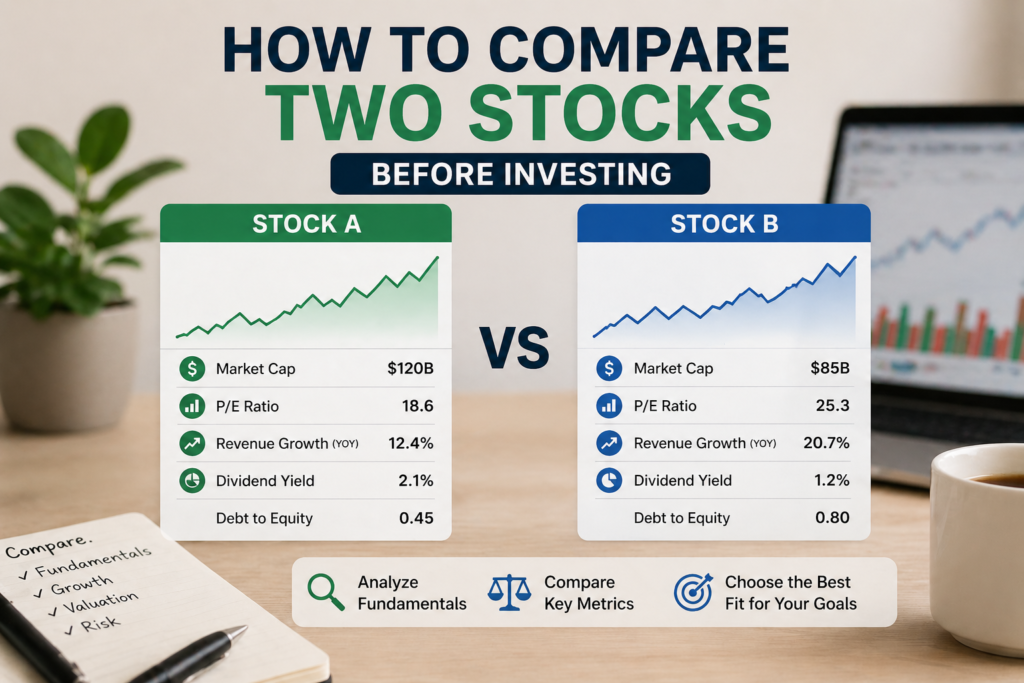
Comparing two stocks before investing is not about guessing which one will go up tomorrow. It is about understanding which business is stronger, which stock is more reasonably valued, which risks you are taking, and which one actually fits your investment goals.
A stock represents ownership in a company, which means that when you buy shares, you are not just buying a ticker symbol on a screen. You are buying a small piece of a real business, with its profits, risks, debt, competition, management decisions, and future potential.
This is where many beginners make mistakes. They compare two stocks only by looking at the share price.
For example:
- Stock A trades at $40.
- Stock B trades at $200.
A beginner might think Stock A is “cheaper.” But the share price alone tells you almost nothing. A $200 stock can be undervalued, and a $40 stock can be expensive. What matters is the value of the business compared with its earnings, growth, debt, cash flow, and future prospects.
In my experience, the smartest way to compare two stocks is not to ask, “Which one is more popular?” The better question is:
Which company gives me the best combination of quality, value, growth, risk control, and portfolio fit?
Let’s break that down step by step.
1. Start With the Business, Not the Stock Price
Before looking at charts, ratios, or analyst opinions, start with a simple question:
What does this company actually do?
If you cannot explain how the company makes money in one or two sentences, you probably should not invest yet.
When comparing two stocks, ask:
| Question | Stock A | Stock B |
|---|---|---|
| What does the company sell? | ||
| Who are its customers? | ||
| How does it make money? | ||
| Is the business easy to understand? | ||
| Is demand likely to grow, shrink, or stay stable? |
This first step matters because investing is not just numbers. A company can look attractive on paper, but if its business model is weak, confusing, or highly dependent on short-term hype, the risk may be higher than it looks.
A simple business is not automatically a good investment. But a business you understand is easier to judge.
2. Compare Revenue Growth
Revenue is the money a company brings in from selling its products or services.
When comparing two stocks, revenue growth helps you understand whether the business is expanding.
Look at:
- Revenue over the last 3 to 5 years.
- Recent quarterly revenue trends.
- Whether growth is consistent or unstable.
- Whether growth comes from real demand or one-time events.
A company with growing revenue may have strong demand, good products, or a growing market. But revenue growth alone is not enough.
A company can increase revenue while still losing money. That is why you need to look at profitability next.
3. Compare Profitability
Profitability shows whether a company can turn sales into actual earnings.
Two companies might both generate $10 billion in revenue, but one may keep far more profit than the other. That difference matters.
Important profitability metrics include:
| Metric | What it tells you |
|---|---|
| Gross margin | How much money remains after direct production costs |
| Operating margin | How profitable the core business is after operating expenses |
| Net income | Final profit after expenses, taxes, and interest |
| Earnings per share | Profit allocated to each share |
| Return on equity | How efficiently the company uses shareholder capital |
FINRA notes that measures such as net income, earnings per share, and price-to-earnings ratios can help investors understand a company’s profits, losses, expenses, and how it uses money.
When I compare two stocks, I do not just ask which company is bigger. I ask which company converts its size into profit more efficiently.
A smaller company with strong margins can sometimes be more attractive than a larger company with weak profitability.
4. Compare Valuation: Which Stock Is Actually Cheaper?
Valuation helps you understand how much investors are paying for a company’s earnings, assets, cash flow, or growth.
This is where beginners often get confused. Again, a lower share price does not mean a stock is cheaper.
A more useful metric is the price-to-earnings ratio, or P/E ratio. FINRA explains that the P/E ratio is calculated by dividing a stock’s current price by its earnings per share, and it shows how much investors are paying for each dollar of company earnings.
Example
| Company | Stock price | Earnings per share | P/E ratio |
|---|---|---|---|
| Stock A | $100 | $5 | 20 |
| Stock B | $50 | $1 | 50 |
Stock B has the lower share price, but it is more expensive relative to earnings.
That does not automatically make Stock B bad. A high P/E can be justified if the company is growing quickly. But it does mean investors are paying more for each dollar of current earnings.
Useful valuation metrics include:
| Metric | Best used for |
|---|---|
| P/E ratio | Comparing profitable companies |
| Forward P/E | Comparing expected future earnings |
| Price-to-sales | Comparing companies with low or no profits |
| Price-to-book | Comparing asset-heavy businesses |
| EV/EBITDA | Comparing companies with different debt levels |
| Dividend yield | Comparing income-producing stocks |
FINRA explains that enterprise value can be used in ratios such as EV/EBITDA and may help compare companies with different debt levels.
The key is to compare similar companies. Comparing a fast-growing technology company with a slow-growing utility using the same valuation expectations can lead to bad conclusions.
5. Compare Debt and Financial Strength
A company can grow fast and still be risky if it carries too much debt.
Debt is not always bad. Many strong companies use debt responsibly. But too much debt can become dangerous, especially when interest rates rise, revenue slows, or profits fall.
When comparing two stocks, check:
- Total debt.
- Cash on hand.
- Debt-to-equity ratio.
- Interest coverage.
- Free cash flow.
- Credit rating, if available.
A company with strong cash flow and manageable debt usually has more flexibility. It can invest in growth, survive downturns, pay dividends, buy back shares, or reduce debt.
A company with weak cash flow and heavy debt may have less room for error.
One thing I always tell beginners: growth is exciting, but financial strength is what helps a company survive when conditions get ugly.
6. Compare Competitive Advantage
A stock is not just a set of numbers. Behind every stock is a company competing against other companies.
A strong company usually has some type of competitive advantage, sometimes called a “moat.”
This could be:
- A powerful brand.
- Lower costs than competitors.
- Network effects.
- Patents or intellectual property.
- High switching costs.
- Better distribution.
- Strong customer loyalty.
- Superior technology.
- Regulatory advantages.
When comparing two stocks, ask:
| Question | Why it matters |
|---|---|
| Why do customers choose this company? | Shows demand strength |
| Can competitors copy it easily? | Shows durability |
| Does the company have pricing power? | Helps protect margins |
| Is the industry growing? | Supports long-term opportunity |
| Is the company gaining or losing market share? | Shows competitive momentum |
A company without a clear advantage may still perform well for a while, but it can be more vulnerable when competition increases.
7. Compare Management Quality
Management matters because leaders decide how the company spends money, handles debt, invests in growth, treats shareholders, and responds to problems.
When comparing two stocks, look at:
- CEO track record.
- Capital allocation decisions.
- Transparency in shareholder letters.
- Insider ownership.
- History of overpromising or underdelivering.
- Share dilution.
- Acquisition decisions.
- Dividend and buyback discipline.
You do not need to become a corporate governance expert, but you should know whether management has created or destroyed value over time.
A strong business with poor management can disappoint investors. A decent business with excellent management can sometimes outperform expectations.
8. Read the Company Filings
For U.S. public companies, annual reports and quarterly reports are valuable sources. Investor.gov explains that Form 10-K and Form 10-Q provide a detailed picture of a company’s business, risks, operating results, financial results, and management’s view of what is driving performance.
When comparing two stocks, do not rely only on social media, headlines, or short summaries.
Look for:
- Business overview.
- Risk factors.
- Revenue breakdown.
- Profit trends.
- Debt levels.
- Cash flow.
- Management discussion.
- Legal issues.
- Customer concentration.
- Future guidance.
The risk section is especially useful. It tells you what could go wrong.
Most beginners only read bullish opinions. Serious investors also read the risks.
9. Compare Dividends and Shareholder Returns
Some stocks pay dividends. Others reinvest profits into growth.
Neither approach is automatically better.
A dividend-paying company may be attractive for income-focused investors. A non-dividend company may be attractive if it can reinvest profits at high rates of return.
When comparing dividends, look at:
| Metric | Why it matters |
|---|---|
| Dividend yield | Shows income relative to stock price |
| Payout ratio | Shows how much profit is paid as dividends |
| Dividend growth | Shows whether payments are increasing |
| Free cash flow coverage | Shows whether dividends are sustainable |
| Buybacks | Shows whether the company returns cash by reducing shares |
Be careful with very high dividend yields. Sometimes a high yield is a warning sign that investors expect the dividend to be cut.
A 3% dividend from a strong, stable company may be better than an 8% dividend from a company under pressure.
10. Compare Risk
Every stock has risk. The goal is not to find a risk-free stock. The goal is to understand what kind of risk you are taking.
Investor.gov defines risk tolerance as an investor’s ability and willingness to lose some or all of an investment in exchange for greater potential returns.
When comparing two stocks, consider these risks:
- Business risk.
- Valuation risk.
- Debt risk.
- Competition risk.
- Regulatory risk.
- Currency risk.
- Interest rate risk.
- Management risk.
- Technology disruption.
- Customer concentration.
- Economic sensitivity.
A fast-growing stock may carry valuation risk. A bank may carry credit and interest rate risk. An energy company may carry commodity price risk. A pharmaceutical company may carry regulatory and patent risk.
The better stock is not always the one with the highest potential return. Sometimes it is the one with a risk profile you can actually handle.
11. Compare Stock Performance Carefully
Stock performance matters, but it can be misleading.
A stock that has gone up a lot may be a great company, or it may be overpriced. A stock that has fallen may be a bargain, or it may be a broken business.
Investor.gov warns that past performance does not necessarily predict future results.
When comparing performance, ask:
- Did the stock rise because earnings improved?
- Did the stock rise because valuation expanded?
- Did the stock fall because of temporary fear?
- Did the stock fall because the business is deteriorating?
- Has performance been consistent or driven by one unusual event?
Do not buy a stock only because it has gone up.
Do not reject a stock only because it has gone down.
Understand why.
12. Compare How Each Stock Fits Your Portfolio
A stock can be excellent and still be wrong for you.
That is why portfolio fit matters.
Investor.gov explains that asset allocation involves dividing investments among categories such as stocks, bonds, and cash. It also notes that diversification can help manage risk by spreading money across different investments.
Before choosing between two stocks, ask:
- Do I already own similar companies?
- Am I too concentrated in one sector?
- Does this stock increase or reduce my overall risk?
- Is this investment aligned with my time horizon?
- Would I be comfortable holding this during a downturn?
- Does this stock fit my goals?
For example, if your portfolio already has several technology stocks, adding another tech stock may increase concentration risk. Even if it is a good company, it may not improve your overall portfolio.
Good investing is not just picking good stocks. It is building a balanced portfolio.
A Simple Stock Comparison Scorecard
Use this table when comparing two stocks before investing.
| Category | Stock A | Stock B | Winner |
|---|---|---|---|
| Business model clarity | |||
| Revenue growth | |||
| Profitability | |||
| Valuation | |||
| Debt and cash flow | |||
| Competitive advantage | |||
| Management quality | |||
| Dividend quality | |||
| Risk level | |||
| Portfolio fit |
Do not choose a stock only because it wins one category.
A stock with better growth may have worse valuation. A cheaper stock may have weaker management. A dividend stock may offer income but limited growth.
The goal is to understand the trade-off.
Example: Comparing Two Stocks in Practice
Imagine you are comparing two companies.
Stock A
- Revenue is growing slowly.
- Profit margins are strong.
- Debt is low.
- The company pays a reliable dividend.
- Valuation is reasonable.
- Growth potential is moderate.
Stock B
- Revenue is growing quickly.
- Profitability is still weak.
- Debt is rising.
- No dividend.
- Valuation is expensive.
- Growth potential is high.
Which stock is better?
There is no automatic answer.
Stock A may be better for a conservative investor who wants stability and income. Stock B may be better for an aggressive investor who accepts higher risk for higher growth potential.
This is why comparing stocks is not just about finding the “best” company. It is about finding the best fit for your strategy.
Red Flags When Comparing Two Stocks
Be careful if one of the stocks has:
- Falling revenue with no clear turnaround plan.
- Rising debt and weak cash flow.
- A very high valuation with slowing growth.
- Management that constantly overpromises.
- Heavy dependence on one customer or product.
- Frequent share dilution.
- Unclear accounting.
- A dividend that looks too high to be sustainable.
- A business model you do not understand.
- Hype-driven buying with weak fundamentals.
In my experience, beginners often ignore red flags when they already want to buy a stock. That is dangerous. A good comparison process should challenge your opinion, not just confirm it.
Final Thoughts: Compare Businesses, Not Just Tickers
When comparing two stocks before investing, do not start with the chart. Start with the business.
Ask which company is stronger, more profitable, more financially stable, better managed, more reasonably valued, and more suitable for your portfolio.
The best stock is not always the fastest-growing one. It is not always the cheapest one. It is not always the most famous one.
A better way to think is:
Which stock offers the best balance between quality, price, growth, risk, and fit?
That is how you move from guessing to investing.
FAQs: How to Compare Two Stocks Before Investing
What is the best way to compare two stocks?
The best way is to compare the business model, revenue growth, profitability, valuation, debt, cash flow, competitive advantage, management quality, risks, and portfolio fit.
Is a lower stock price always better?
No. A lower share price does not mean a stock is cheaper. Valuation metrics such as P/E ratio, price-to-sales, and EV/EBITDA are more useful for comparison.
What is the most important metric when comparing stocks?
There is no single perfect metric. P/E ratio, revenue growth, profit margins, free cash flow, and debt levels are all useful, depending on the type of company.
Should beginners compare stock charts?
Charts can be useful, but beginners should not rely only on price movement. A stock chart shows what happened to the price, not necessarily whether the business is strong or fairly valued.
How do I know if a stock is overvalued?
A stock may be overvalued if its price is high compared with earnings, sales, cash flow, or growth expectations. But valuation depends on the company’s quality, future growth, and risk.
Should I buy the stock with higher growth?
Not always. Higher growth can come with higher risk and higher valuation. A slower-growing company may be a better investment if it is more profitable, stable, and reasonably priced.
Can two good stocks both be bad investments?
Yes. Even good companies can be bad investments if you pay too much, misunderstand the risks, or add too much concentration to your portfolio.