
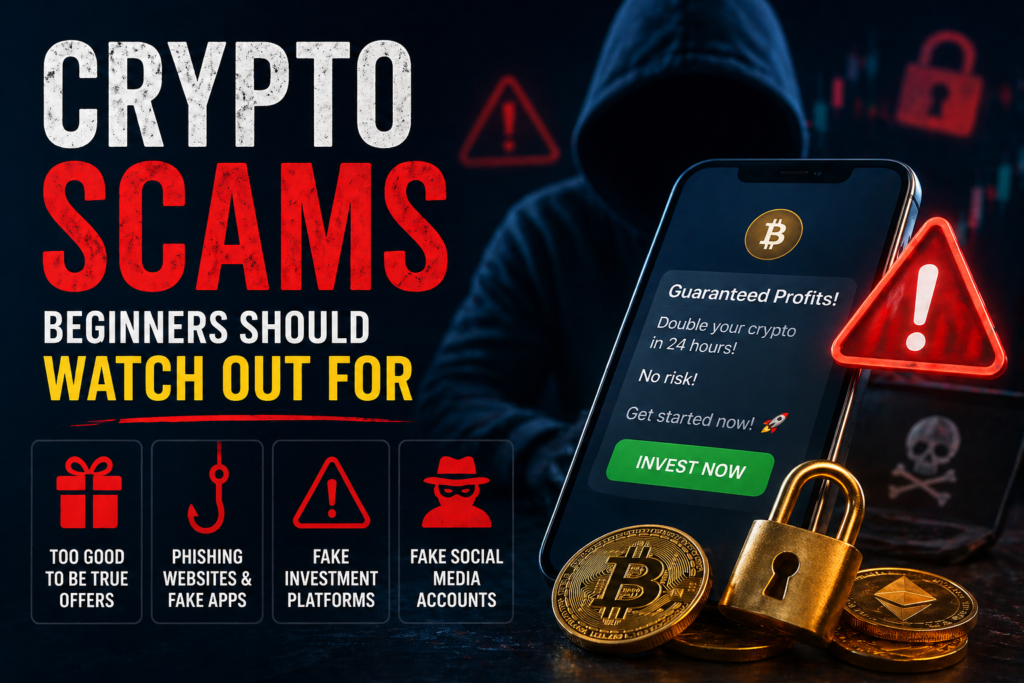
Crypto can be exciting for beginners. It feels fast, modern, global, and full of opportunity. But that same excitement is exactly what scammers use against new investors.
The biggest danger for beginners is not only choosing a volatile coin. It is trusting the wrong person, clicking the wrong link, sending funds to the wrong wallet, or believing a fake platform that looks real enough to fool almost anyone.
The FBI reported that in 2025, Americans who filed complaints involving cryptocurrency reported more than $11 billion in losses, and investment fraud remained the main driver of scam-related losses. The FBI also warned that scammers now use fake profiles, voice clones, fake documents, and believable videos to pressure victims into sending money or personal information.
As someone who has seen how beginners approach investing, my advice is simple: before you ask, “Can this crypto make me money?”, ask, “How could this be a scam?”
That one question can save you a lot of pain.
Why Beginners Are Targeted by Crypto Scammers
Beginners are attractive targets because they often know just enough to be curious, but not enough to spot the traps.
Scammers know this. They use technical language, fake dashboards, urgent messages, social proof, screenshots of fake profits, and promises that sound just believable enough. They do not always look like obvious criminals. Sometimes they look like helpful mentors, online friends, dating matches, customer support agents, recruiters, influencers, or investment “professors.”
The FTC warns that scammers often demand payment in cryptocurrency because crypto payments are hard to reverse. It also says that only scammers guarantee profits or big returns, and that people should never mix online dating with crypto investment advice.
The beginner mistake is assuming scams are easy to spot. Many are not. Modern crypto scams are polished, patient, and emotionally intelligent.
1. Fake Crypto Investment Platforms
Fake investment platforms are one of the most dangerous crypto scams for beginners.
Here is how they usually work. Someone contacts you online, shows you an “opportunity,” and sends you to a professional-looking website or app. The dashboard shows your money growing. At first, you may even be allowed to withdraw a small amount. That small withdrawal is bait. It makes the platform feel real.
Then you deposit more.
When you finally try to withdraw a larger amount, the problems begin. The platform may say you need to pay taxes, unlock fees, verification fees, anti-money-laundering fees, or account upgrade fees. But the profits are fake, the account is fake, and the extra payment is just another part of the scam.
The FBI explains that crypto investment fraud often involves victims being coached to put more and more money into what appears to be a highly profitable platform, only to discover they cannot withdraw their funds.
Red flags to watch for
- The platform was recommended by someone you met online.
- The website promises unusually high returns.
- You are pressured to deposit quickly.
- You are told to send crypto to a wallet address.
- You cannot verify the company properly.
- Withdrawals suddenly require extra fees.
- Customer support only exists through chat apps.
A real investment platform should not need emotional pressure, secrecy, or surprise withdrawal fees.
2. Romance Crypto Scams
Romance crypto scams are especially cruel because they do not start with money. They start with trust.
A scammer may meet you through a dating app, social media, or even a random “wrong number” text. They build a relationship slowly. They may talk to you every day, share personal stories, and make the connection feel real.
Then, once trust is established, they introduce crypto investing.
They might say they have a successful trading strategy. They might claim a family member works in finance. They might show screenshots of profits. They might offer to “teach” you. At first, it feels personal and generous.
It is not.
The SEC describes relationship investment scams as long cons where scammers build trust through friendship or romance before convincing victims to put money into phony investments. These scams are also known as romance scams, financial grooming scams, or “pig butchering” scams.
The biggest warning sign
If someone you met online starts giving you crypto investment advice, stop.
It does not matter how kind they seem. It does not matter how long you have talked. It does not matter if they have photos, video calls, or a convincing story.
The FTC’s guidance is blunt: if someone from a dating app wants to show you how to invest in crypto or asks you to send crypto, it is a scam.
3. Pump-and-Dump Schemes
A pump-and-dump happens when scammers hype a crypto asset, token, or memecoin to push the price up. Once enough people buy in, the promoters sell their holdings, the price collapses, and late buyers are left with losses.
Beginners often fall for this because the scam looks like a community movement. Everyone seems excited. Social media posts are everywhere. Influencers are talking about it. Telegram or Discord groups are full of people saying they are buying more.
But hype is not analysis.
The SEC warns that fraudsters may create or promote crypto assets, including memecoins, through social media or pre-sales, then sell before the hype ends. After the promoters sell, the price can drop rapidly and other buyers may lose most of their money.
Red flags to watch for
- “This coin is about to explode.”
- “Get in before it lists.”
- “Guaranteed 100x.”
- “The whales are buying.”
- “Only early investors will win.”
- “Do not miss this once-in-a-lifetime chance.”
In my experience, beginners are most vulnerable when they feel late. FOMO makes people skip research. Scammers know that.
4. Fake Celebrity or Influencer Giveaways
Fake crypto giveaways are everywhere during bull markets.
The scam is simple: someone impersonates a celebrity, billionaire, influencer, exchange founder, or well-known investor. The post or video says that if you send crypto to a wallet, you will receive double or triple back.
You will not.
The FTC warns that scammers may pretend to be celebrities running giveaways and claim they will multiply any crypto you send. But victims simply end up sending their crypto directly to a scammer’s wallet.
This scam has become more dangerous because AI makes fake videos, fake voices, and fake endorsements easier to create. The SEC has warned that scammers may use AI to create deepfakes of celebrities, government officials, or even loved ones to gain trust and convince people to send funds.
Simple rule
No legitimate celebrity needs you to send crypto first so they can send more crypto back.
That is not a giveaway. That is theft with better marketing.
5. Phishing Scams and Fake Wallet Links
Phishing scams try to steal your private information, wallet access, seed phrase, or login credentials.
You might receive:
- A fake exchange email.
- A fake wallet support message.
- A fake airdrop link.
- A fake NFT minting page.
- A fake security alert.
- A fake “verify your wallet” request.
- A fake customer service DM.
The goal is to make you click a link and connect your wallet, enter your seed phrase, or approve a malicious transaction.
For beginners, the most important rule is this:
Never share your seed phrase with anyone.
Your seed phrase is the master key to your wallet. If someone gets it, they can take your funds. Real support teams do not need it. Real exchanges do not ask for it in a DM. Real wallet apps do not ask you to type it into random websites.
Red flags to watch for
- Urgent “your account will be locked” messages.
- Links sent by direct message.
- Slightly misspelled domains.
- Fake support accounts.
- Requests to connect your wallet.
- Requests for your seed phrase or private key.
- “Claim your free tokens now” messages.
When in doubt, do not click the link. Open the official website or app manually.
6. Fake Crypto Recovery Scams
Recovery scams target people who have already been scammed.
This is one of the lowest forms of fraud. After someone loses money, a second scammer appears and claims they can recover the crypto. They may pretend to be a hacker, investigator, lawyer, government agent, blockchain expert, or recovery company.
They ask for an upfront fee.
Then they disappear.
The FBI warns victims of cryptocurrency investment fraud not to pay for services that claim they can recover lost funds, because these are often scams too. It also recommends immediately stopping all payments and reporting the fraud to IC3.
The SEC also warns that fraudsters may target people who already lost money by asking them to send private keys or pay additional money to recover funds.
What to do instead
If you have been scammed, stop sending money. Save screenshots, wallet addresses, transaction hashes, names, websites, phone numbers, emails, and chat history. Then report it to the relevant authorities.
Do not trust someone who promises guaranteed recovery.
7. Fake Crypto Jobs and Task Scams
Fake crypto job scams are becoming more common.
A scammer pretends to recruit you for remote work. The job may involve reviewing products, completing tasks, testing apps, optimizing data, or helping with crypto transactions. At first, the work seems easy. Then you are told you must deposit your own money or crypto to unlock tasks, complete assignments, or withdraw your earnings.
That is the scam.
The FBI says some work-from-home scams involve criminals posing as legitimate company employees, providing online training, and then requiring victims to deposit their own money through crypto or money transfers into a platform to complete the job.
Red flags to watch for
- You are hired without a real interview.
- The company only communicates through messaging apps.
- You must pay to work.
- Your “earnings” are locked until you deposit more.
- The recruiter avoids video calls or official company email.
- The job description is vague but promises easy money.
A real job pays you. It does not require you to send crypto first.
8. Fake Group Chats and “Trading Professors”
Another common scam starts with a group chat.
You may be added to a WhatsApp, Telegram, Discord, or social media group where everyone seems to be making money. There may be a “professor,” “coach,” “assistant,” or “analyst” giving signals. Other members post screenshots of profits. The group feels active and successful.
But many of those members may be fake.
The SEC warns that fraudsters use investment group chats to impersonate well-known experts or create fake leaders, sometimes using AI deepfake videos. These groups may show fake profits and then demand fees, taxes, or deposits when victims try to withdraw money.
Beginner rule
Do not invest because a group chat feels convincing.
Screenshots can be faked. Testimonials can be scripted. Profit dashboards can be invented. The louder the group, the more carefully you should verify everything.
9. Fake Mining or Staking Platforms
Some scams promise easy passive income through crypto mining, cloud mining, staking, liquidity pools, or trading bots.
The pitch usually sounds like this:
- “Earn daily guaranteed income.”
- “No risk.”
- “AI-powered returns.”
- “Passive income forever.”
- “Deposit today and start earning instantly.”
Real staking and mining can exist, but scammers use those terms to make fake platforms sound technical and legitimate.
The SEC and CFTC have warned that fraudulent digital asset trading websites may claim to use proprietary crypto trading systems or mining farms while promising high guaranteed returns with little or no risk. They also warn that some fraudsters ask investors to pay additional costs, such as supposed taxes, before withdrawing fake profits.
How to protect yourself
Be skeptical of any crypto product that promises guaranteed yield. Ask where the return comes from, what risks exist, who controls the funds, whether the company is registered where required, and whether you can independently verify the platform.
If the explanation is full of jargon but light on proof, walk away.
10. Impersonation Scams
Scammers often impersonate trusted people or institutions.
They may pretend to be:
- A crypto exchange.
- A wallet provider.
- A government agency.
- A regulator.
- A bank.
- A police officer.
- A tax authority.
- A famous investor.
- A friend or family member.
- A customer support agent.
The FTC says scammers often impersonate businesses, government agencies, and love interests in crypto-related scams.
The SEC also warns that communications may falsely appear to come from official sources, including the SEC, and that AI has made it easier for fraudsters to impersonate agencies, organizations, individuals, friends, and family members.
The safest response
Do not reply through the message you received. Go to the official website manually, use verified contact details, and confirm the issue independently.
If someone says you must pay in crypto to fix a tax problem, unlock an account, protect funds, or avoid arrest, assume it is a scam.
The Crypto Scam Red Flag Checklist
Before sending crypto, ask yourself:
- Did this opportunity come from a stranger online?
- Is anyone promising guaranteed returns?
- Am I being rushed?
- Am I being told not to tell family, friends, or an adviser?
- Do I need to send crypto to unlock profits?
- Is the platform new or hard to verify?
- Does the website look professional but lack real company details?
- Is customer support only available through messaging apps?
- Did someone ask for my seed phrase or private key?
- Did I meet this person through dating, social media, or a random text?
- Are the profits shown only on a private dashboard?
- Do I need to pay taxes or fees before withdrawing?
- Is the person trying to move me to WhatsApp, Telegram, or another encrypted app?
The FBI lists several warning signs of crypto investment fraud, including unsolicited online contacts, pressure to invest quickly, moving conversations to encrypted messaging apps, being told to limit contact with advisers or family, and difficulty withdrawing funds unless additional fees or taxes are paid.
If two or more red flags appear, stop.
What To Do If You Think You Are Being Scammed
If you think you are in a crypto scam, do not try to “test” the scammer with more money. Do not pay one more fee to unlock funds. Do not argue. Do not warn them that you are reporting them.
Take these steps:
- Stop sending money immediately.
- Stop communicating with the scammer.
- Do not share private keys, seed phrases, ID documents, or banking details.
- Save all evidence: screenshots, emails, chats, wallet addresses, transaction IDs, websites, phone numbers, and names.
- Report the scam to the appropriate authority.
- Warn your bank, exchange, or wallet provider if relevant.
- Be careful of recovery scammers.
The FBI recommends reporting suspected cryptocurrency investment fraud to IC3 as soon as possible and documenting the scammer or company name, contact methods, dates, payment methods, where funds were sent, and a full description of the interactions.
Fast reporting does not guarantee recovery, but waiting usually helps the scammer, not you.
Final Thoughts: In Crypto, Caution Is a Skill
Crypto scams beginners should watch out for are not always obvious. Many are professional, patient, emotional, and technically convincing.
That is why the best protection is not paranoia. It is process.
Slow down. Verify independently. Ignore guaranteed returns. Never send crypto because a stranger told you to. Never share your seed phrase. Never trust a dashboard just because it shows profits. Never pay extra fees to withdraw money from a suspicious platform. And never confuse online attention with financial expertise.
In my opinion, the smartest beginner in crypto is not the person chasing the fastest gain. It is the person who knows when to walk away.
If something feels urgent, secret, guaranteed, romantic, or too good to be true, take a beat.
That pause might be the most profitable decision you ever make.
FAQs About Crypto Scams Beginners Should Watch Out For
What is the most common crypto scam for beginners?
One of the most common and damaging scams is fake crypto investment platforms, often connected to romance scams, wrong-number texts, social media messages, or group chats. Victims see fake profits but cannot withdraw real money.
How do I know if a crypto platform is fake?
Be suspicious if the platform was recommended by a stranger, promises guaranteed returns, has limited company information, uses only chat support, asks for more crypto to withdraw, or pressures you to invest quickly.
Are crypto giveaways real?
Legitimate promotions may exist, but any giveaway that requires you to send crypto first to receive more crypto back is a scam. No real celebrity or exchange needs your crypto deposit to send you a prize.
Can I recover crypto after being scammed?
Sometimes authorities or platforms may help trace funds, but recovery is difficult and never guaranteed. Be very careful with anyone who promises guaranteed recovery for an upfront fee.
Is it safe to take crypto advice from someone I met online?
No. Be extremely skeptical of crypto advice from strangers, dating matches, random texts, social media contacts, or group chats. Relationship-based investment scams are a major warning area.
What should I never share with anyone?
Never share your seed phrase, private key, wallet password, two-factor authentication codes, exchange login, or identity documents with someone you do not fully trust and independently verify.
What should I do before investing in any crypto project?
Research the team, company, token, platform, risks, fees, liquidity, legal status, security, and independent reviews. Search the name plus words like “scam,” “complaint,” or “review,” and never invest only because of hype.
So interesting!!