
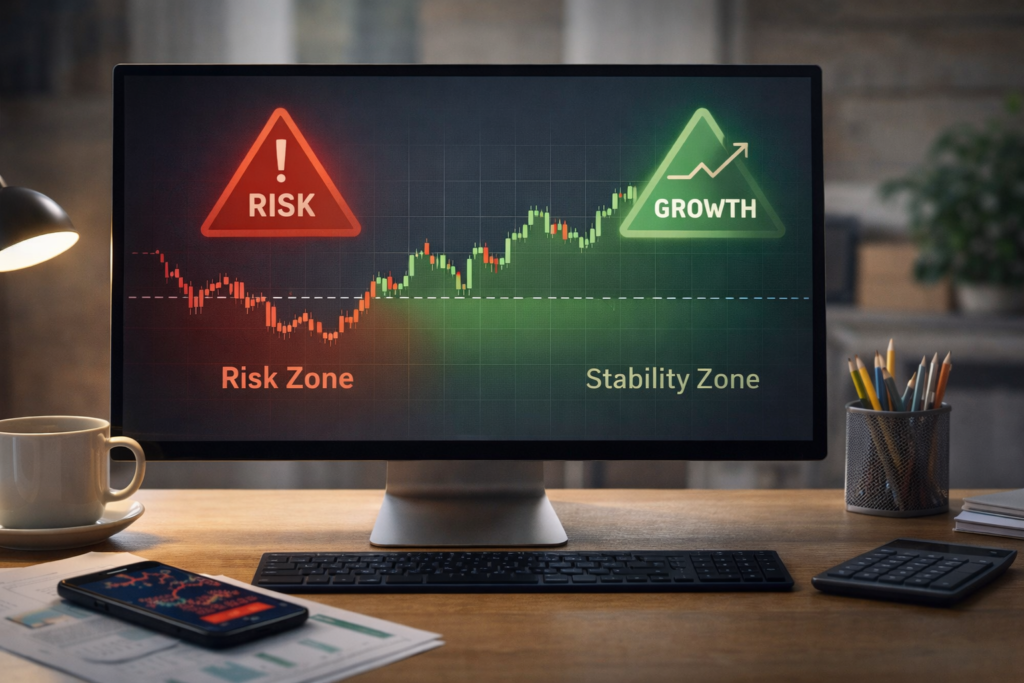
One of the most common questions beginners ask is whether investing is risky. The short answer is yes, investing always involves some level of risk. But that does not mean investing is something you should fear or avoid. It simply means that money placed into investments can go up or down in value, and there are no guaranteed outcomes.
For many people, the word risk sounds negative. It brings ideas of losing money, making mistakes, or taking dangerous chances. But in investing, risk is not just about loss. It is also about uncertainty. The future is never fully predictable, and that is why investing involves risk in the first place.
Understanding risk is one of the most important steps for any beginner. Many people either ignore risk completely or become too afraid of it. Neither approach is helpful. The smartest investors learn how risk works, how to manage it, and how to make decisions that fit their own goals.
In this guide, you will learn what investment risk really means, what types of risk matter most, and how beginners can reduce unnecessary risk while still giving their money a chance to grow.
What Does Risk Mean in Investing?
In investing, risk means the possibility that the value of your investment may fall or that the result may be different from what you expected. In simple terms, risk is the chance that things do not go the way you hoped.
This can happen in many forms. A stock can lose value. A market can fall during a recession. A company can perform badly. An asset that seemed promising can disappoint investors. Even an investment that usually grows over time can go through periods of decline.
Risk is not always a sign of a bad investment. In fact, most investments that offer growth also come with some uncertainty. The key is not trying to eliminate risk completely, because that is almost impossible. The real goal is to understand the kind of risk you are taking and decide whether it makes sense for you.
When beginners first invest, they often focus only on potential returns. They ask how much they might gain, but they do not spend enough time asking what could go wrong. A more balanced mindset looks at both sides.
Why Higher Returns Usually Mean Higher Risk
One of the most important ideas in investing is that risk and reward are usually connected. Investments with higher potential returns often come with greater uncertainty. Investments that are more stable usually offer slower growth.
For example, a very volatile asset might rise quickly, but it can also fall just as fast. On the other hand, a more diversified and stable investment may not deliver dramatic short-term gains, but it can provide steadier long-term performance.
This relationship is important because it helps explain why no investment can offer everything at once. If something promises very high returns with no risk, that should immediately make you suspicious. In real investing, there is almost always a trade-off.
Beginners often get into trouble when they chase the highest possible returns without understanding the level of risk involved. This is especially common in trendy assets, speculative investments, or markets driven by hype.
A better approach is to ask whether the level of risk matches your knowledge, your goals, and your emotional tolerance. A good investment is not just one that can grow. It is one that you can actually hold through uncertainty.
Different Types of Investment Risk
Risk is not just one thing. There are several types of risk, and understanding them can help you make better decisions.
Market risk is one of the most common. This is the risk that prices across the market may fall because of economic conditions, bad news, or investor fear. Even strong investments can lose value when the overall market drops.
Company risk affects individual businesses. If you invest in a single stock, the success of your investment depends heavily on that company. Poor leadership, weak earnings, or bad decisions can hurt its value.
Volatility risk refers to how sharply an investment moves up and down. Some assets are very stable, while others can change dramatically in a short period. High volatility often creates stress for beginners because it makes outcomes feel less predictable.
Inflation risk is another important one. If your money grows too slowly, inflation can reduce its real value over time. This means that even if you are not losing money directly, your purchasing power may still be falling.
There is also emotional risk, which many beginners underestimate. This is the risk of making bad decisions because of fear, greed, impatience, or panic. Sometimes the biggest threat to a portfolio is not the market itself, but the investor’s reaction to it.
Is It Possible to Invest Without Risk?
Not really. Every investment carries some form of risk. Even keeping money in cash has its own risk because inflation can slowly reduce its value over time.
What changes from one investment to another is not whether risk exists, but how much risk there is and what kind of risk you are exposed to. Some investments are more aggressive, while others are more defensive. Some are suitable for long-term growth, while others are designed for stability.
This is why asking whether investing is risky is only the first step. The better question is: what kind of risk am I comfortable with, and how can I manage it wisely?
Many beginners assume that avoiding investing is the safest option. In the short term, that may feel true. But over the long term, doing nothing can also have consequences. If your money does not grow, you may lose opportunities to build wealth or protect yourself from inflation.
So the goal is not to avoid all risk. The goal is to choose risk carefully.
How Beginners Can Reduce Risk
The good news is that beginners can do a lot to reduce unnecessary risk.
One of the best ways is diversification. Instead of putting all your money into one investment, you spread it across different assets. This lowers the chance that one bad result will damage your entire portfolio. That is one reason many beginners start with broad investment options rather than trying to depend on a single company.
Another way to reduce risk is to invest only in things you understand. If you cannot explain what an investment is, why people buy it, and what could make it go up or down, then you probably should not put money into it yet.
Starting small is also a smart move. Beginners do not need to take large positions immediately. A smaller start gives you room to learn, build confidence, and make mistakes without major consequences.
Long-term thinking reduces risk as well. In the short term, markets can be unpredictable. Over longer periods, quality investments have more time to recover from downturns and benefit from growth.
Most importantly, risk becomes easier to manage when you have a clear plan. Random investing usually creates more stress. Purposeful investing creates more control.
Emotional Risk Is More Serious Than Most People Think
A lot of beginners assume risk only comes from the market, but emotions create many investment mistakes. Fear can make people sell too early. Greed can make them chase overpriced assets. Impatience can push them into bad decisions because they want faster results.
This emotional side of investing is one of the biggest reasons why two people can buy similar assets and get very different results. One person stays calm, follows a plan, and thinks long term. The other reacts to every headline and changes strategy every few days.
Emotional risk is dangerous because it often feels rational in the moment. Selling during a fall can feel like protection. Buying into hype can feel like opportunity. But these reactions are often driven more by emotion than by logic.
A good strategy should protect you not only from market risk, but also from your own impulses. Simplicity, discipline, and patience are powerful tools because they reduce emotional decision-making.
Risk Depends on the Person
Not every investment has the same level of risk for every person. The same portfolio may feel comfortable to one investor and stressful to another. This is why beginners should avoid copying others blindly.
Your age, income, goals, experience, and personality all affect how much risk makes sense for you. Someone investing for the long term may be able to accept more short-term volatility. Someone who is very cautious may need a slower and more stable approach.
This is not about being brave or afraid. It is about being honest. A strategy only works if you can stick with it. If your investments cause constant anxiety, the problem may not be the market itself. It may be that your risk level is too high for your current stage.
The best investment plan is one you can realistically follow over time.
Conclusion
Yes, investing is risky, but that does not mean it is reckless or dangerous by default. Risk is simply part of how investing works. When you invest, you accept uncertainty in exchange for the possibility of growth.
The important thing is not avoiding risk completely, but understanding it. Once you know what risk means, what forms it can take, and how to manage it, investing becomes much less intimidating. Diversification, patience, knowledge, and emotional discipline can all help reduce unnecessary risk.
For beginners, the smartest approach is to keep things simple and build confidence gradually. You do not need to take extreme risks to become a successful investor. You just need to understand what you are doing and stay consistent over time.