
Starting to invest is an exciting step, but once you understand the basics, a new question usually appears: how should you actually organize your investments? Many beginners learn what stocks, ETFs, and cryptocurrencies are, but they still feel unsure when it comes to putting everything together into one plan.
This is where the idea of a portfolio becomes important. An investment portfolio is simply the combination of assets you choose to hold. It can include different types of investments, different risk levels, and different goals. Building your first portfolio is not about creating something perfect. It is about creating something balanced, simple, and suitable for your current stage as a beginner.
A lot of new investors think they need a complex strategy from the beginning, but that is not true. In fact, most beginners do better when they keep things simple. A well-built portfolio should help you grow your money while reducing unnecessary risk. It should feel manageable, understandable, and consistent with your goals.
In this guide, you will learn how to build your first investment portfolio step by step and what principles matter most when you are just starting.
What Is an Investment Portfolio?
An investment portfolio is the collection of all the assets you own as an investor. Instead of putting all your money into one place, you spread it across different investments. These can include stocks, ETFs, bonds, cryptocurrencies, or even cash reserves depending on your strategy.
The purpose of a portfolio is not only to grow money but also to manage risk. Every type of investment behaves differently. Some are more stable, while others are more volatile. Some grow slowly over time, while others can move sharply in either direction.
By combining different assets, you create a structure that is usually stronger than relying on one investment alone. This is one of the most important ideas in investing. A good portfolio is not just about chasing the highest returns. It is also about building something that can survive uncertainty and market changes.
For a beginner, understanding this concept is more important than trying to build an advanced strategy. The goal is to make smart choices that are easy to maintain over time.
Start With Your Goal
Before choosing any investments, you should ask yourself a simple question: why are you investing?
Your answer matters because your portfolio should match your goal. Some people invest to build long-term wealth. Others want to save for retirement, create future financial security, or simply learn how investing works. Your time horizon, risk tolerance, and financial situation all depend on that goal.
If your objective is long-term growth, you may be more comfortable with assets that fluctuate in the short term but have stronger potential over time. If your goal is more short-term or cautious, your portfolio may need a more conservative structure.
Many beginners skip this step and jump directly into buying assets. But a portfolio without a clear goal often becomes random. You end up buying investments because they sound interesting rather than because they serve a purpose.
A portfolio works better when every part of it has a reason to be there.
Diversification Is the Foundation
If there is one principle every beginner should understand, it is diversification. Diversification means spreading your money across different investments instead of placing it all in one asset.
This matters because no investment is guaranteed to perform well all the time. A company can have a bad year. A sector can fall out of favor. A cryptocurrency can lose value very quickly. If all your money is concentrated in one place, your risk becomes much higher.
A diversified portfolio reduces this problem. It allows stronger parts of your portfolio to help balance weaker ones. This does not eliminate risk completely, but it makes your investments more stable and manageable.
For beginners, diversification often means starting with broad assets such as ETFs and then adding smaller positions in other investments if appropriate. This creates a core structure that is easier to maintain.
Diversification is one of the biggest reasons why many beginners prefer ETFs when building a first portfolio. They offer exposure to many companies at once and make it easier to avoid overdependence on one asset.
Keep It Simple at the Beginning
One of the biggest mistakes new investors make is trying to build a portfolio that is too complicated. They buy too many assets, mix too many strategies, and create a structure they do not fully understand.
Simplicity is often more effective, especially at the beginning. A simple portfolio is easier to track, easier to understand, and easier to stick with during market changes.
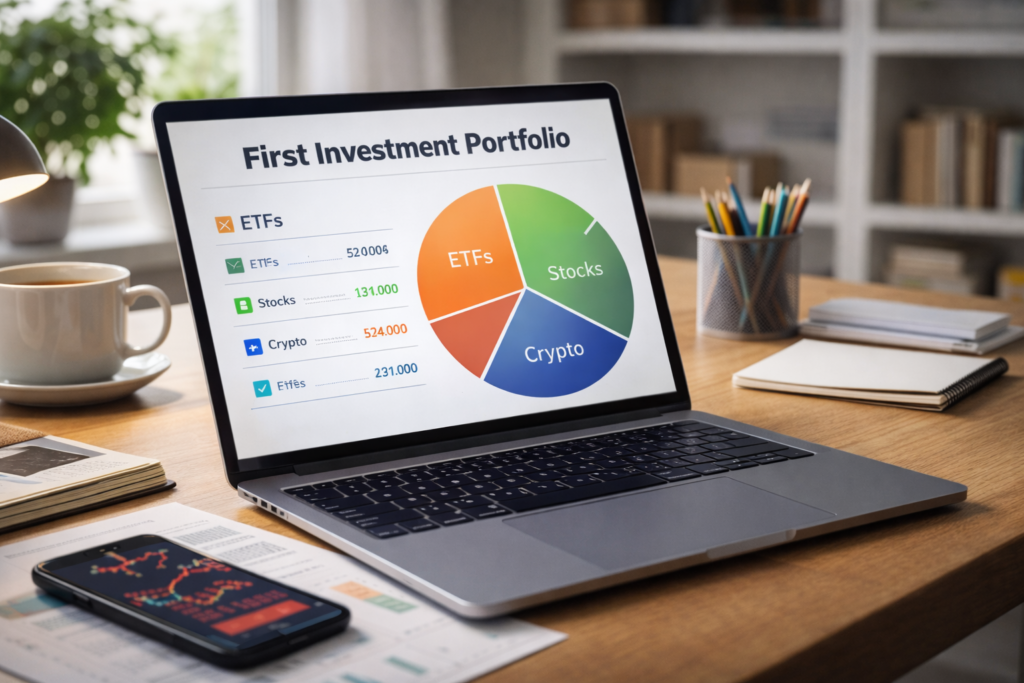
For example, a beginner portfolio might include a large portion in ETFs, a smaller portion in individual stocks, and a very small portion in crypto if the investor understands the risks. That is already enough to start learning and growing without creating unnecessary confusion.
You do not need ten different strategies or twenty different holdings to be a real investor. In fact, keeping your first portfolio simple can help you avoid emotional decisions and build confidence faster.
A simple portfolio also makes it easier to review what is working and what is not. Complexity often creates noise, while simplicity creates clarity.
Understand Your Risk Tolerance
Every investor has a different relationship with risk. Some people are comfortable seeing temporary losses if they believe in long-term growth. Others feel anxious when their portfolio drops even a little. Neither reaction is wrong, but it is important to know yourself.
A good portfolio should match your emotional tolerance as well as your financial goals. If your portfolio is too aggressive for your personality, you may panic during market downturns and make poor decisions. If it is too conservative, you may feel frustrated by slow growth.
This is why beginners should not copy someone else’s portfolio blindly. What works for one person may not work for another.
Risk tolerance is influenced by age, income, knowledge, personality, and goals. A younger investor with a long time horizon may accept more volatility. Someone more cautious may prefer a more stable setup.
The best portfolio is not the one that looks impressive. It is the one you can actually stay committed to.
A Simple Example of a Beginner Portfolio
Many beginners want to see a simple example, not because they should copy it exactly, but because examples help make the idea more practical.
A beginner portfolio could be built with a strong core in diversified ETFs, a smaller part in individual stocks, and a very limited allocation to higher-risk assets such as crypto. The exact percentages are less important than the principle behind them.
The larger part of the portfolio should usually be the more stable and diversified part. This helps create a solid base. Smaller parts can then be used for learning, growth opportunities, or higher-risk exposure if the investor understands the trade-offs.
The goal is not to chase excitement. The goal is to create balance. If one part of the portfolio becomes volatile, the rest can help reduce the impact.
This kind of structure helps beginners participate in growth while keeping risk at a more manageable level.
Review, But Do Not Obsess
Once you have built your first portfolio, it is normal to want to check it all the time. Many beginners open their apps daily, watch every movement, and react emotionally to every rise or fall.
This habit usually creates stress rather than better results.
A portfolio is meant to work over time, not minute by minute. Of course, reviewing your investments is important. You should understand what you own and occasionally check whether your portfolio still matches your goals. But there is a difference between reviewing and obsessing.
The more often you stare at every movement, the more tempted you become to make unnecessary changes. Long-term investing works best when paired with patience and discipline.
Your portfolio does not need constant action. It needs consistency, understanding, and time.
You Can Improve It Over Time
A beginner portfolio does not have to be perfect. In fact, it almost certainly will not be. That is completely normal.
Your first portfolio is just the beginning of your learning process. As your knowledge grows, you may decide to adjust your asset mix, reduce certain risks, or add new investments. That is part of becoming a better investor.
The important thing is to start with a structure you understand. It is much easier to improve a simple portfolio over time than to fix a complicated one created without a plan.
Many investors learn best by starting with something small and manageable, then refining it gradually. Investing is not a one-time decision. It is an ongoing process.
That is why your first portfolio should be seen as a foundation, not as a final product.
Conclusion
Building your first investment portfolio does not need to be complicated. The best beginner portfolios are usually simple, diversified, and based on clear goals. By understanding what a portfolio is, why diversification matters, and how risk should match your personality, you can create a strong starting point.
You do not need to know everything before you begin. What matters most is building something you understand and can stay committed to. A simple portfolio built with patience and discipline is far better than a complex one built from confusion.
Over time, your portfolio can grow along with your experience. The key is to start with a solid foundation and improve step by step.