
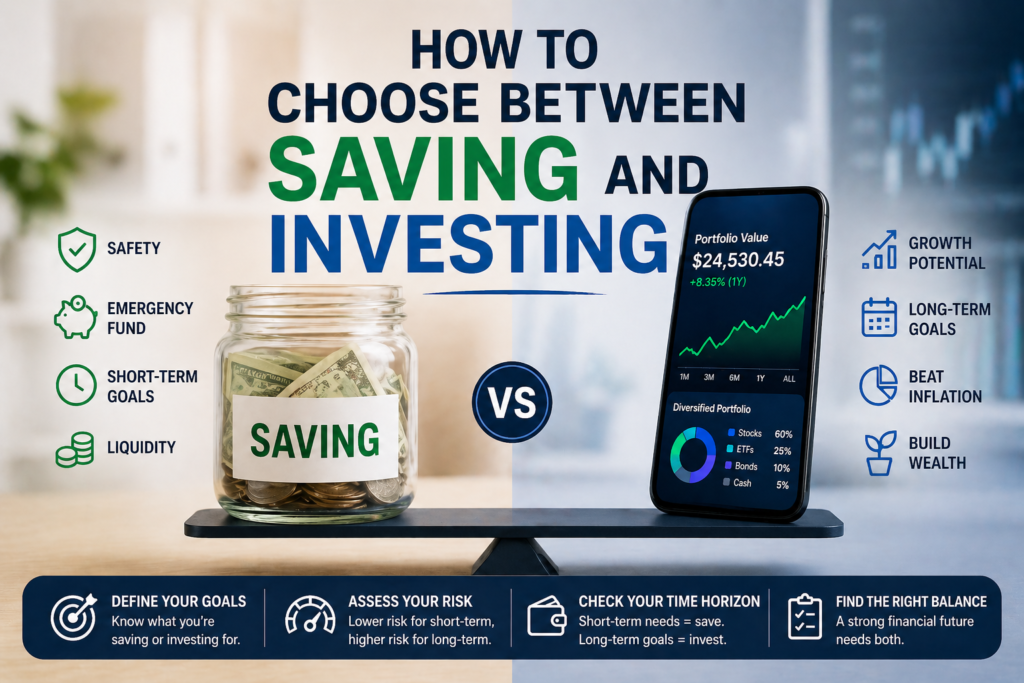
Choosing between saving and investing is one of the most important money decisions beginners face. It also happens to be one of the easiest to overcomplicate.
Some people save too much and never give their money a chance to grow. Others invest too early, without an emergency fund, and end up selling at the worst possible time when life gets expensive. The smartest approach is not “saving is better” or “investing is better.” The smartest approach is knowing which tool fits which goal.
Saving and investing are both useful, but they solve different problems. Saving is usually about safety, access, and short-term stability. Investing is about long-term growth, accepting risk, and giving your money time to work.
MoneyHelper defines saving as putting money somewhere relatively safe and accessible, such as a bank account, while investing means putting money into assets such as company shares, property, or funds, where the value can rise or fall but may offer higher rewards over time.
In my experience, most beginners do not make bad money decisions because they are careless. They make them because they use the wrong tool for the wrong job. They invest money they need soon, or they keep long-term money sitting in cash for years while inflation quietly reduces its buying power.
This guide will help you decide when to save, when to invest, and when to do both.
Saving vs. Investing: What Is the Difference?
Saving means setting money aside somewhere stable and easy to access. This could be a savings account, current account, money market account, certificate of deposit, or another low-risk cash option depending on your country.
Investing means buying assets that have the potential to grow over time. These might include stocks, bonds, ETFs, mutual funds, index funds, retirement funds, or property-related investments.
The difference is not just where the money goes. The difference is what you expect from it.
| Saving | Investing |
|---|---|
| Lower risk | Higher risk |
| Easier access | Better for long-term growth |
| Best for emergencies and short-term goals | Best for long-term goals |
| Usually lower returns | Potentially higher returns |
| Less volatility | Value can rise and fall |
| Protects stability | Builds wealth over time |
Investor.gov explains that savings are usually kept in safe places that allow access to money, but the trade-off is that they typically earn lower interest. The same source notes that some people keep money in savings for emergencies, then look to investing for longer-term growth because inflation can reduce the purchasing power of cash over time.
So the real question is not:
Should I save or invest?
The better question is:
What is this money for, and when will I need it?
That question gives you the answer.
When Saving Is the Better Choice
Saving is usually the better choice when you need safety, flexibility, and quick access to your money.
This is especially true for money you may need within the next few months or years. If your money has a short deadline, the stock market may not give you enough time to recover from a downturn.
MoneyHelper says short-term goals are generally those within the next five years and that, for short-term goals, the general rule is to use cash deposits such as bank accounts rather than stock-market investments.
Save for emergencies first
An emergency fund is money set aside for unexpected expenses or financial emergencies. The Consumer Financial Protection Bureau describes it as a cash reserve for unplanned costs such as car repairs, home repairs, medical bills, or loss of income.
This should usually come before serious investing.
Why? Because if you invest without emergency savings, life can force you to sell investments at the wrong time. A market drop is uncomfortable. A market drop plus an urgent bill is much worse.
FINRA notes that an emergency fund can help you manage unexpected expenses or temporary income loss without taking on substantial debt or liquidating investments. It also says financial planners often recommend three to six months of living expenses, though people with variable income may need more.
That does not mean you need to be perfect before investing. But you should have some financial cushion.
Save for short-term goals
Saving is usually better for goals like:
- Rent or mortgage payments.
- Emergency expenses.
- A holiday next year.
- A car purchase.
- A wedding fund.
- A house deposit needed soon.
- Insurance bills.
- Tax payments.
- School fees due shortly.
If losing 20% of the money would ruin the goal, that money probably should not be invested aggressively.
A simple rule I like:
If you need the money soon, save it. If you can leave it alone for years, consider investing it.
Save when you cannot afford volatility
Investing involves ups and downs. Even good investments can fall in value. If a temporary drop would make you panic, miss bills, or abandon your plan, saving may be more appropriate for that money.
MoneyHelper warns that investments can go down as well as up, meaning you could lose money. It also says the decision to invest depends on how much cash you have available, your attitude to risk, your capacity for loss, and your personal circumstances.
This is important. Risk tolerance is not just about personality. It is also about real life.
Someone with stable income, low expenses, no dependents, and a long timeline may be able to take more investment risk. Someone with unstable income, high expenses, debt pressure, or family responsibilities may need more cash security.
When Investing Is the Better Choice
Investing is usually the better choice when your goal is long-term growth and you can leave the money invested for several years.
Saving protects your money today. Investing helps your money grow for tomorrow.
Investor.gov says investing may have more risk than keeping money in the bank, but it gives you a better chance to create wealth over time. It also encourages investing regularly over time, such as a fixed amount each pay period, and continuing through your career.
Invest for long-term goals
Investing is often more suitable for goals like:
- Retirement.
- Financial independence.
- Long-term wealth building.
- A child’s future education.
- Buying a home many years from now.
- Building a portfolio.
- Protecting future purchasing power from inflation.
MoneyHelper describes longer-term goals as those where you will not need the money for ten years or more, such as retirement, and says investing may be worth considering for longer-term goals because inflation can seriously affect the value of cash savings over time.
The longer your timeline, the more time your investments have to recover from short-term market drops.
That does not make investing risk-free. It never is. But time gives you more flexibility.
Invest when inflation matters
Inflation means prices rise over time. If your savings earn less than inflation, your money may technically grow but still buy less in the future.
This is one reason long-term money sitting entirely in cash can be risky in a different way. It may feel safe because the balance does not bounce around, but its purchasing power can decline.
In my opinion, this is one of the most misunderstood parts of saving vs. investing. Beginners often think risk only means “my investment might fall.” But there is also a risk that your cash does not grow enough to keep up with the cost of living.
Saving is safer in the short term. Investing may be more useful for long-term purchasing power.
Invest when you can be consistent
Investing works best when it becomes a habit.
You do not need to invest a huge amount at the beginning. A regular monthly contribution can be more powerful than waiting years for the “perfect” time to start.
Investor.gov recommends starting an emergency fund and investing regularly over time, such as a fixed amount from each pay period, while increasing contributions when possible.
This is where many beginners overthink. They want the perfect stock, the perfect market entry, the perfect app, the perfect strategy. But for long-term investing, consistency often matters more than perfection.
The Key Question: When Will You Need the Money?
Time horizon is the cleanest way to decide between saving and investing.
Here is a simple framework:
| When you need the money | Better option | Why |
|---|---|---|
| 0–12 months | Save | You need stability and access |
| 1–3 years | Usually save | Market drops could hurt your goal |
| 3–5 years | Mostly save, maybe cautious investing | Depends on flexibility and risk tolerance |
| 5–10 years | Mix of saving and investing | Depends on goal and comfort with risk |
| 10+ years | Usually invest | More time for growth and recovery |
MoneyHelper separates goals into short-term goals within five years, medium-term goals between five and ten years, and longer-term goals of ten years or more. It says cash is generally preferred for short-term goals, while investing may be considered for longer-term goals.
This timeline-based approach is simple but effective.
For example:
- Money for rent next month? Save.
- Money for a car in six months? Save.
- Money for a house deposit in two years? Save.
- Money for retirement in 30 years? Invest.
- Money for financial independence in 15 years? Invest.
- Money for a possible home purchase in seven years? Maybe a mix.
The shorter the timeline, the more damaging volatility can be. The longer the timeline, the more damaging low growth can be.
What About Debt?
Before choosing between saving and investing, look at your debt.
High-interest debt can quietly destroy your finances. If you are paying expensive credit card interest, payday loan interest, or other high-cost borrowing, investing may not be the best first move.
FINRA says that if you cannot pay off all high-interest debt immediately, you should create a plan for regular, sustainable payments, and think about whether the money saved on interest could later go toward productive investing.
This does not mean you must pay off every type of debt before investing. A low-interest mortgage is different from high-interest credit card debt.
A practical order might look like this:
- Build a small starter emergency fund.
- Pay down high-interest debt.
- Build a stronger emergency fund.
- Start investing for long-term goals.
- Increase investing as your finances stabilize.
In my experience, beginners often want to skip straight to investing because it feels more exciting. But reducing expensive debt can sometimes be the most powerful “return” available.
Saving and Investing Together
You do not always have to choose one or the other.
In many cases, the best answer is to save and invest at the same time, but for different purposes.
For example:
| Goal | Action |
|---|---|
| Emergency fund | Save |
| Holiday next year | Save |
| Retirement | Invest |
| House deposit in 7 years | Save and possibly invest cautiously |
| Long-term wealth | Invest |
| New laptop in 6 months | Save |
This is how financially healthy people often structure their money. They do not put everything in cash, and they do not invest every dollar. They assign each dollar a job.
A beginner-friendly approach could be:
- Keep emergency money in savings.
- Keep short-term goal money in savings.
- Invest long-term money regularly.
- Review the split once or twice per year.
That is simple. And simple is good.
How Much Should You Save Before Investing?
There is no perfect number for everyone.
The right amount depends on:
- Your monthly expenses.
- Job stability.
- Number of income sources.
- Health costs.
- Dependents.
- Rent or mortgage obligations.
- Insurance coverage.
- Debt level.
- Comfort with risk.
A common target is three to six months of essential expenses in an emergency fund. MoneyHelper says it is a good idea to have at least three to six months of living expenses saved in an instant-access savings account, including rent, food, utilities, and essential bills.
But do not let that number discourage you.
If saving three to six months feels impossible right now, start smaller. Build $250. Then $500. Then one month of expenses. Momentum matters.
The CFPB notes that even a small amount set aside can provide some financial security, especially for people living paycheck to paycheck or with irregular income.
The goal is not to become perfect before investing. The goal is to reduce the chance that one surprise bill destroys your plan.
How Much Should You Invest?
Once your short-term safety needs are covered, investing becomes more important.
A common beginner question is: “How much should I invest?”
The honest answer is: it depends. But a useful starting point is to invest an amount you can maintain consistently without hurting your monthly life.
Investor.gov gives examples such as investing 5% or 10% of income, or another fixed amount you can afford each pay period.
For beginners, consistency is more important than trying to impress yourself with a huge amount.
You might start with:
- $25 per month.
- $50 per month.
- $100 per month.
- 5% of income.
- 10% of income.
- Enough to get an employer retirement match, if available.
If your income rises, you can increase contributions. If life gets difficult, you can adjust. The important thing is to build the habit.
The Decision Framework: Save, Invest, or Both?
Use this simple framework before deciding what to do with your money.
Step 1: Do you need the money within five years?
If yes, saving is usually the better choice.
Money needed soon should not depend on market performance. A stock market drop at the wrong time can turn a good goal into a stressful problem.
Step 2: Do you have an emergency fund?
If no, prioritize saving at least some emergency cash.
FINRA says your emergency fund should be liquid, accessible, and kept somewhere like a savings account at a bank or credit union where you can withdraw without penalty.
Step 3: Do you have high-interest debt?
If yes, consider focusing on debt repayment while maintaining some savings.
High-interest debt can create a guaranteed drag on your finances.
Step 4: Is the goal long term?
If yes, investing may be appropriate.
Long-term money usually has more time to recover from volatility and benefit from growth.
Step 5: Can you emotionally handle market drops?
If no, start cautiously.
Risk tolerance matters. It is better to invest in a way you can stick with than to choose an aggressive strategy you abandon during the first downturn.
Common Mistakes Beginners Make
Mistake 1: Investing emergency money
This is risky because emergencies do not wait for markets to recover.
Your emergency fund should be boring, accessible, and stable. It is not supposed to maximize returns. It is supposed to protect your life.
Mistake 2: Saving everything forever
Cash is useful, but keeping all long-term money in savings can limit wealth building.
Investor.gov points out that savings may offer security and access, but low interest can struggle against inflation, which is why many people use investing for longer-term growth.
Mistake 3: Ignoring the timeline
The same money cannot have two jobs.
If the money is for a home deposit next year, it should not be treated like retirement money. If the money is for retirement, it should not sit forever like next month’s rent.
Mistake 4: Taking too much risk too early
Beginners sometimes invest aggressively before they understand volatility. Then the market falls, and they sell in panic.
The better approach is to learn, start simple, diversify, and only take risk you understand.
Mistake 5: Waiting too long to invest
Some people wait until they know everything. That day never comes.
You do not need to master every financial concept to start investing. You need a basic plan, a long-term goal, and a sensible amount of risk.
Simple Examples
Example 1: You have no emergency fund
You have $1,000 saved and no emergency fund.
Better move: save first.
Put that money somewhere accessible. Build a small cushion before taking investment risk.
Example 2: You have six months of expenses saved
You have no high-interest debt and $12,000 in emergency savings.
Better move: start investing for long-term goals.
You may still keep saving for short-term goals, but extra long-term money can begin working through investments.
Example 3: You want to buy a house in two years
You have $20,000 for a deposit.
Better move: save.
A two-year timeline is usually too short for risky investments.
Example 4: You want to retire in 25 years
You have stable income and emergency savings.
Better move: invest regularly.
A long time horizon gives you more opportunity to benefit from compounding and market growth.
Example 5: You have credit card debt
You have $5,000 in credit card debt at a high interest rate.
Better move: keep some emergency savings, then attack the debt.
Investing while expensive debt grows in the background may slow your progress.
Final Thoughts: The Best Choice Depends on the Job of the Money
Saving and investing are not enemies. They are partners.
Saving gives you stability. Investing gives you growth potential. Saving helps you handle the next emergency. Investing helps you build the next decade.
The mistake is expecting one tool to do everything.
If you need the money soon, save it. If you need safety, save it. If you are building an emergency fund, save it. If the goal is long term and you can handle risk, invest it. If you have both short-term and long-term goals, do both.
The best financial plan is not the one that sounds impressive. It is the one that fits your actual life.
In my view, the smartest beginner move is this:
Build enough savings to feel stable, then invest consistently enough to grow.
That balance is where real progress begins.
FAQs About Saving vs. Investing
Is it better to save or invest?
It depends on when you need the money. Saving is usually better for emergencies and short-term goals. Investing is usually better for long-term goals where you can accept risk and leave the money alone for years.
How much should I save before investing?
A common target is three to six months of essential expenses in an emergency fund, but you can start smaller if that feels unrealistic. The most important first step is building the habit of saving.
Should I invest if I have debt?
If you have high-interest debt, it may make sense to focus on paying it down while keeping some emergency savings. Lower-interest debt may not need to stop you from investing, depending on your situation.
Is investing riskier than saving?
Yes. Investments can rise and fall in value. Saving is usually more stable and accessible, but it may offer lower returns and may not keep up with inflation over long periods.
When should I invest instead of save?
Consider investing when your emergency fund is in place, high-interest debt is under control, and the money is for a long-term goal such as retirement or wealth building.
Can I save and invest at the same time?
Yes. Many people save for short-term needs while investing for long-term goals. This is often the most balanced approach.
What is the biggest mistake beginners make?
One of the biggest mistakes is investing money they need soon. Another is keeping all long-term money in cash and never allowing it to grow.